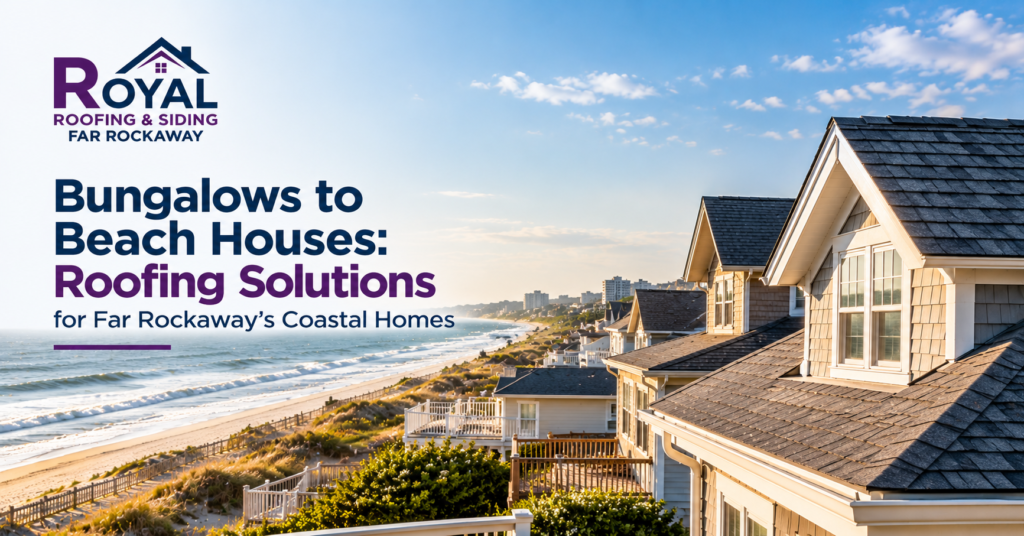
Quick Answer: Far Rockaway bungalow roofing depends on the home’s roof form, wood deck, dormers, porch connections, and lot conditions. The Beach 24th–26th Street bungalow district brings older decks, multiple short roof planes, and tight access. Raised and rebuilt beach houses bring longer roof edges, exposed penetrations, and stronger demands on attachment and perimeter detailing.
Far Rockaway contains several coastal home types within a short distance of the Atlantic Ocean and Jamaica Bay, including the Beach 24th–26th Street bungalow district, older one- and two-family houses, elevated homes, post-Sandy rebuilds, Edgemere bungalows, and bungalow clusters in Rockaway Beach.
The Beach 24th–26th Street district is listed on the New York State and National Registers of Historic Places.
Far Rockaway Beach Bungalow Historic District
Development of the Beach 24th–26th Street bungalow district began in 1921 on part of the former Dickerson Estate. The district covers Beach 24th, Beach 25th, and Beach 26th Streets between Seagirt Avenue and the ocean, with about 100 contributing buildings.
These homes are generally compact one-and-a-half-story wood-frame buildings. Gable, hipped, and clipped-gable roofs appear alongside porches, dormers, narrow lots, and close spacing between neighboring properties. The result is a roof layout with many transitions in a small footprint.
Historic Status and Roofing Work
The listing on the State and National Registers documents the bungalows’ historic importance. It is separate from a New York City landmark designation, so the register listing itself does not create a Landmarks Preservation Commission approval requirement for ordinary privately funded roof work.
The building’s actual condition still controls the roofing scope. A roof replacement needs a review of the deck, dormers, porch intersections, roof edges, flashing, ventilation, and previous repair layers before new materials cover the assembly.
Decking, Dormers, and Older Roof Layers
A bungalow roof covering often looks serviceable while the wood deck beneath it carries years of moisture exposure. Deck condition receives close attention around valleys, eaves, dormers, porch connections, former leak locations, and areas where several roof planes meet.
Previous repairs leave their own pattern. Multiple shingle layers, patched porch roofs, altered dormers, replacement skylights, and different flashing metals often converge on a compact roof. Those junctions deserve more attention than an uninterrupted shingle field because water follows transitions.
The deck also affects fastening. A wind-rated shingle attached to deteriorated sheathing does not provide the same protection as a complete assembly attached to sound wood. Correcting weak sections during the roofing work creates a stable base for the new covering.
Tight Lots and Neighboring Structures
Narrow separation between bungalow properties affects staging, ladder placement, material delivery, protective coverings, and debris removal. The access plan needs to protect siding, porches, windows, fences, shared paths, and neighboring roof edges during tear-off and installation.
Bungalow roofing requires organized movement of materials, tear-off debris, ladders, and protective coverings through narrow side yards, alleys, porches, or shared paths. Careful access protects the surrounding property and gives the crew a clear route to roof edges hidden from the street.
The same spacing makes some roof details difficult to view from the ground. A professional assessment needs safe access to the sidewalls, eaves, valleys, dormers, and roof edges facing the adjoining property.
Dormer and Porch Water Paths
Dormers add sidewalls, valleys, headwall flashing, and small roof-to-wall joints. Porches add another roof plane and another location where water moves toward the main wall. Each transition needs a continuous water-shedding path and secure flashing.
A ceiling stain beneath a dormer or porch intersection does not always mark the entry point. Water travels along decking, rafters, and wall framing before becoming visible inside, so the inspection follows the connected roof planes rather than one isolated spot.
Bungalows Beyond Beach 24th–26th Streets
Royal Roofing & Siding Far Rockaway also serves bungalow properties outside the registered district. Edgemere contains older low-rise homes in a low-lying, bay-facing setting, where stormwater and flood exposure create conditions that differ from the ocean-side blocks near the historic district. Rockaway Beach contains bungalow clusters alongside multifamily buildings, so roof work often takes place within a mixed low-rise and high-rise setting.
These locations require the same attention to aging decks, roof transitions, and drainage, with the surrounding exposure shaping the inspection. An Edgemere bungalow brings bay-side moisture and flood planning into the conversation. A Rockaway Beach bungalow brings tighter coordination with nearby multifamily buildings, shared access, and neighboring roof systems.
Raised and Rebuilt Far Rockaway Beach Houses
Far Rockaway’s post-Sandy recovery produced elevated and rebuilt one- to four-family homes alongside older properties. Newer framing and roof assemblies reduce some age-related concerns, yet exposed roof connections remain vulnerable to wind-driven rain, salt, and storm uplift.
Wind Attachment at Long Roof Edges
A raised or rebuilt home often has broader roof planes than a compact bungalow. The inspection therefore focuses on the continuity of the deck, underlayment, edge metal, fascia, soffit, rake details, flashing, and roof-to-wall connections.
Shingle fastening, membrane attachment, corner treatment, perimeter restraint, and penetration flashing all need to work as one assembly. A secure center field does not compensate for a loose rake edge, incomplete drip edge, weak fascia connection, or poorly attached vent.
Exposed Penetrations and Coastal Metal
Roof vents, pipe boots, skylights, equipment supports, gutters, clips, fasteners, and flashing remain exposed to Atlantic air and strong sunlight. Their condition often controls water entry before the broad shingle or membrane field shows visible failure.
The assembly needs compatible fasteners, flashing, sealants, and adjoining metals selected for the home’s exposure. The focus is the complete connection detail around each penetration and edge rather than the panel, shingle, or membrane alone.
Drainage Across Larger Roof Areas
Broader roof planes move more water during heavy rain. Gutters and downspouts on pitched roofs need clear outlets and secure connections. Low-slope sections need drains, scuppers, overflow routes, and adequate slope toward those outlets.
Persistent ponding after outlets are clear points to a slope, structural, or design condition. Clearing debris alone does not resolve a roof area that holds water because of inadequate fall or a damaged deck.
Far Rockaway Coastal Home Types and Roofing Priorities
| Far Rockaway home type | Roof and building features | Roofing priority |
| Beach 24th–26th Street bungalow district | Compact wood-frame homes, gables or hips, dormers, porches, narrow side access | Review the older deck, valleys, dormer flashing, porch transitions, and staging plan |
| Edgemere bungalow | Older low-rise home in a low-lying, bay-facing setting | Trace moisture paths, protect the deck, and connect roof drainage with the property’s flood exposure |
| Rockaway Beach bungalow cluster | Low-rise bungalow group near multifamily buildings and shared access conditions | Coordinate access, inspect roof transitions, and protect neighboring structures during the work |
| Elevated or rebuilt beach house | Larger roof planes, raised structure, exposed edges and penetrations | Prioritize attachment, roof-to-wall connections, perimeter detailing, and compatible coastal components |
| Low-slope addition or flat-roof section | Membrane, drains, scuppers, curbs, hatches, and penetrations | Maintain seams, flashing, perimeter attachment, outlets, and overflow paths |
Roofing Materials for Far Rockaway Roof Shapes
Material selection follows roof pitch, framing, deck condition, exposure, drainage, appearance, and maintenance access. The material table below connects common systems with the Far Rockaway roof forms where their details receive the closest attention.
| Roofing system | Far Rockaway application | Details that require attention |
| Wind-rated asphalt shingles | Pitched bungalow roofs and one- or two-family homes | Stable deck, fastening pattern, underlayment, valleys, dormers, eaves, and roof edges |
| Metal roofing | Selected pitched beach-house designs and compatible additions | Coating, fastener and flashing compatibility, dissimilar-metal control, and edge attachment |
| EPDM membrane | Suitable low-slope additions, garages, and flat-roof sections | Seams, pipe boots, drains, scuppers, curbs, perimeter attachment, and ponding |
| TPO membrane | Suitable low-slope sections requiring heat-welded seams | Weld quality, flashing, penetrations, drains, scuppers, and edge restraint |
Maintenance for Far Rockaway Coastal Homes
After Wind or Heavy Rain
From the ground, inspect for displaced shingles, lifted edge metal, loose gutters, missing components, impact marks, and debris. Inside, check ceilings and upper walls around dormers, roof-to-wall intersections, skylights, vents, and porch connections.
A professional storm inspection reaches the edges, transitions, and deck areas that ground-level viewing misses. Bungalow inspections focus on dormers, porches, valleys, and older decking. Raised-home inspections focus on perimeter attachment, penetrations, and roof-to-wall details.
Keep Roof Water Moving
Clear gutters, downspouts, drains, and scuppers before heavy rain seasons and after major storms. Edgemere properties also require attention to the relationship between roof discharge and the property’s low-lying site conditions.
Track Small Defects Before They Spread
Record pitted flashing, rusted fasteners, cracked sealants, loose vents, damaged edge metal, recurring stains, and ponding. A maintenance record shows whether one detail remains isolated or several connected components are deteriorating together.
Repair or Replacement for Far Rockaway Bungalows and Beach Houses
Repair fits a limited defect at one dormer, porch tie-in, pipe boot, flashing joint, or edge where the surrounding deck and roof assembly remain sound. Replacement fits a bungalow with widespread deck deterioration or multiple failing roof planes, and a raised home with broad perimeter damage, repeated leakage, or failing connections across the assembly.
The building type shapes the review. Bungalow replacement includes the condition of older wood decking and compact transitions. Raised-home replacement includes the continuity of edge attachment, roof-to-wall connections, penetrations, and drainage across the larger roof.
Choosing a Roofing Contractor for a Far Rockaway Home
A bungalow project requires experience with compact wood-frame homes, dormers, porch intersections, older decking, narrow access, and neighboring structures. An elevated or ocean-adjacent project requires detailed knowledge of wind attachment, roof edges, roof-to-wall transitions, drainage, and compatible coastal components.
The inspection needs to precede the recommendation. A bungalow’s age alone does not define its roof condition, and a newer beach house still requires close review of exposed connections and metal components.
Far Rockaway Roofing Built Around the Home
A Beach 24th–26th Street bungalow, an Edgemere bungalow, a Rockaway Beach cluster home, and a raised beach house each require a roofing plan tied to their roof form, deck, exposure, access, and drainage.
For bungalow, beach-house, flat-roof, shingle, storm-damage, or replacement concerns, contact Royal Roofing & Siding Far Rockaway at 718-831-6489 to schedule a professional inspection.
FAQs: Bungalow and Beach House Roofing in Far Rockaway
What makes Far Rockaway bungalow roofing different?
Compact wood-frame construction, older decks, dormers, porches, several short roof planes, narrow lots, and close neighboring structures shape the inspection and roofing plan.
Does the Far Rockaway Beach Bungalow Historic District listing require LPC approval for roof work?
The listing on the State and National Registers recognizes the district’s history and remains separate from city landmark designation. The register listing alone does not create a Landmarks Preservation Commission approval requirement for ordinary privately funded roof work.
How does Edgemere bungalow roofing differ from the Beach 24th–26th Street district?
Edgemere bungalows sit in a lower, bay-facing setting with different stormwater and flood exposure. The roof inspection still covers decks, transitions, flashing, and drainage, with the property’s site conditions included in the assessment.
What roofing details matter on a raised Far Rockaway beach house?
Perimeter attachment, roof-to-wall connections, eaves, rakes, fascia, soffits, vents, skylights, pipe boots, flashing, and drainage receive close attention across the larger roof planes.
Which roofing materials fit Far Rockaway coastal homes?
Wind-rated asphalt shingles fit many pitched bungalows and houses. Compatible metal, EPDM, and TPO systems fit selected roof shapes after the pitch, deck, exposure, drainage, and connection details receive review.
When does a Far Rockaway bungalow need roof replacement?
Replacement fits widespread deck deterioration, multiple failing roof planes, repeated leakage, or connected damage across dormers, porches, valleys, and edges. A localized defect surrounded by sound materials fits targeted repair.
How often does a Far Rockaway coastal home need a roof inspection?
An annual professional inspection provides a useful baseline, with additional inspections after significant wind, heavy rain, impact damage, or new interior leakage.