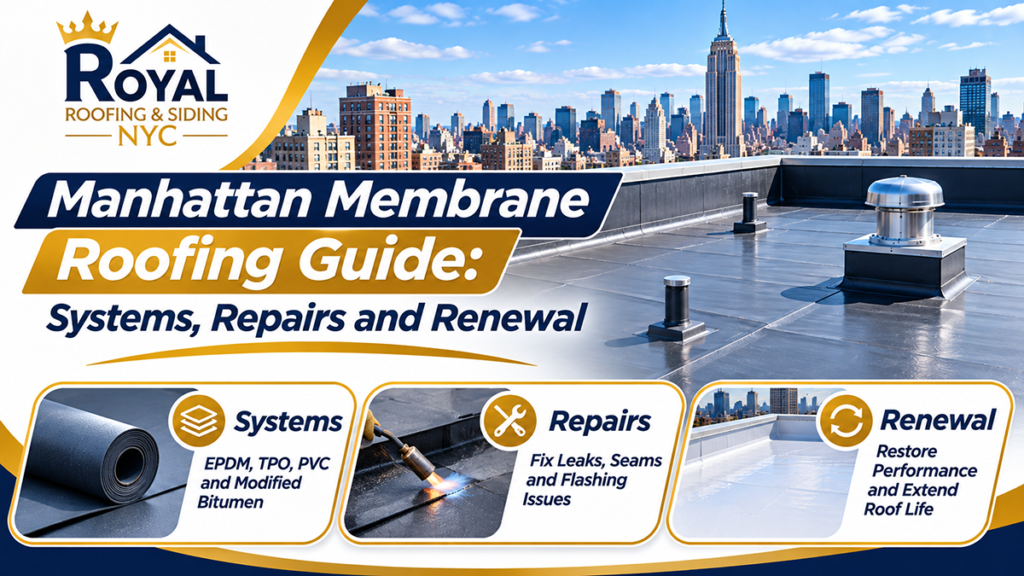
Quick Answer: Manhattan membrane roof systems perform best when membrane type, insulation, cover board, drainage, parapet transitions, rooftop equipment, and repair history are evaluated together. TPO, PVC, EPDM, and modified bitumen use different seam and repair methods, so renewal starts with identifying the existing assembly and its condition.
Why Manhattan Membrane Roofs Need System-Specific Planning
Low-slope membrane roofs appear across Manhattan apartment buildings, co-ops, condos, mixed-use properties, commercial buildings, lofts, and high-rises. The roof environment varies sharply from one property to another.
Midtown roofs often contain dense mechanical equipment and numerous penetrations. SoHo and Tribeca properties frequently combine broad low-slope areas with skylights, exhaust equipment, and several roof elevations. Upper East Side and Upper West Side buildings often include parapets, internal drains, bulkheads, and older roof sections joined to later renovations.
Those conditions affect membrane performance. Drains concentrate runoff into small areas. Parapets create long roof-to-wall transitions. Equipment curbs interrupt the waterproofing plane. Different repair generations also introduce changes in materials across one roof.
| Membrane System | Connection Method | Strong Fit | Main Repair Focus |
|---|---|---|---|
| TPO | Heat-welded thermoplastic seams | Reflective low-slope roofs and broad roof fields | Welds, punctures, drains, curbs |
| PVC / PVC KEE | Heat-welded thermoplastic seams | Mixed-use roofs with grease or chemical exposure | Seams, penetrations, contaminated zones |
| EPDM | Rubber membrane with taped or adhesive seams | Flexible low-slope renovation assemblies | Seams, flashing, patches, punctures |
| Modified bitumen | Reinforced asphaltic sheets | Older multifamily, walkup, and mixed-use roofs | Laps, flashing, blisters, surface wear |
The strongest material choice is the one that fits the existing deck, roof geometry, attachment method, drainage, rooftop use, and future repair requirements.
TPO, PVC, and EPDM on Manhattan Roofs
TPO Membrane Systems
TPO is a thermoplastic single-ply membrane joined through heat-welded seams. GAF’s single-ply roofing systems page lists mechanically attached, adhered, induction-welded, and fleece-back TPO assemblies, giving designers several attachment approaches for different decks and roof conditions.
On Manhattan buildings, TPO often fits broad roof fields where reflectivity, welded seams, and compatibility with rooftop equipment layouts are priorities. Localized damage usually centers on punctures, seam areas, drains, curbs, penetrations, or roof edges.
Repair starts with correct cleaning and surface preparation. Compatible TPO material is then welded into the existing membrane according to system requirements. Generic mastics do not replace properly prepared thermoplastic repair work.
PVC and PVC KEE Membranes
PVC uses heat-welded seams like TPO but offers different chemical-resistance characteristics. GAF’s single-ply guidance positions PVC systems for demanding commercial environments, including roofs exposed to grease and other contaminants.
That characteristic is useful on Manhattan mixed-use buildings with food-service exhaust near the roof. The material decision still includes curb design, discharge location, cleaning, drainage, and protection around the affected area.
PVC KEE systems add modifiers intended to preserve flexibility and performance within the membrane. Repair still depends on identifying the exact existing material, preparing the aged surface, and welding compatible membrane into the original system.
EPDM Membrane Systems
EPDM is a synthetic rubber membrane rather than a thermoplastic sheet. Its seams and flashing use compatible primers, tapes, adhesives, and repair products instead of heat welding.
The Elevate Building Owner Manual separates maintenance and repair considerations for EPDM and thermoplastic systems and directs owners to watch for wear, contamination, cuts, punctures, and damaged details.
That distinction matters on Manhattan roofs with older repairs. An EPDM patch needs products designed for rubber roofing, while a TPO or PVC repair relies on thermoplastic welding. Correct system identification prevents incompatible products from being layered over one another.
Modified Bitumen and Hybrid Manhattan Roofs
Modified bitumen remains common on older walkups, multifamily buildings, mixed-use properties, rear extensions, and roofs that have developed through several renovation cycles.
The system uses reinforced asphaltic sheets installed through methods such as heat welding, cold adhesive, or self-adhered application. Repair preparation therefore differs from both EPDM and thermoplastic membrane work.
Hybrid roofs are especially important in Manhattan. A modified-bitumen main roof sometimes meets a newer TPO section around mechanical equipment, an EPDM roof over a rear extension, or coated areas installed during an earlier restoration. Each material has different cleaning, priming, flashing, and repair requirements.
Material boundaries need to be mapped before renewal. One section often remains stable while another reaches a point where localized repair no longer provides dependable service. Mapping those boundaries helps preserve sound roofing rather than treating the building as one uniform membrane.
The Layers Beneath the Membrane Matter
The visible membrane is only the top part of the roof assembly. Deck, insulation, cover board, attachment, flashing, vapor-control components where present, and drainage all influence performance.
Wet insulation below an intact-looking surface changes the repair decision. Crushed cover board beneath a heavily traveled route creates a weaker base, while deck movement transfers stress into seams and flashing.
Cover board provides a firmer layer beneath the membrane and is especially useful where roof activity is concentrated. Insulation also affects drainage when tapered components direct water toward internal drains or scuppers.
Terrace systems create another challenge. Pavers, pedestals, planters, and walking surfaces conceal the membrane and sometimes hide drain locations. Renewal planning needs removable access around drains, wall transitions, and high-risk details so future inspection remains practical.
Membrane Repairs Need the Right Method
A puncture in EPDM and a puncture in TPO look similar from above, but the repair process is different. Modified bitumen introduces another set of materials and preparation requirements.
| Repair Finding | TPO / PVC | EPDM | Modified Bitumen |
|---|---|---|---|
| Cut or puncture | Prepare and weld compatible membrane | Clean, prime, and install compatible EPDM repair | Prepare and install compatible asphaltic patch |
| Open seam | Rework affected welded seam | Rebuild with approved seam materials | Repair lap according to membrane type |
| Failed curb flashing | Remove failed detail and weld new flashing | Rebuild with compatible flashing products | Reflash with compatible sheet system |
| Wet insulation below defect | Remove wet material before closing repair | Remove wet material before closing repair | Remove wet material before closing repair |
| Traffic damage | Restore membrane and protect route | Restore membrane and protect route | Restore roof and protect route |
Aged membranes need careful preparation because dirt, oxidation, residue, and earlier repair products affect adhesion and weld quality. Surface condition therefore becomes part of the repair method rather than a separate cleanup step.
Repeated repairs in one location point toward a problem beyond the surface. Substrate movement, poor drainage, equipment traffic, weak flashing geometry, or moisture below the membrane often explains why the same area keeps reopening.
Drainage and Ponding Affect Membrane Performance
Low-slope membrane roofs rely on internal drains, scuppers, overflow routes, and roof slope to move water away. Manhattan equipment layouts often complicate that path.
Dunnage, pipes, conduit, curbs, and mechanical supports divide large roof fields into smaller drainage zones. Debris collects behind those obstructions, while settlement around insulation or drains creates recurring low areas.
A drain that is open does not guarantee good drainage. Water still remains where the surrounding roof surface slopes away from the outlet or where insulation has compressed.
NYC Building Code Chapter 15 governs roof assemblies, flashing, drainage, reroofing, and recover work. Section 1511 restricts recovery over water-soaked or badly deteriorated roofing and where the existing roof already has two or more applications of roof covering.
Persistent pondering therefore needs diagnosis before renewal. Drain blockage, settlement, deck deflection, compressed insulation, and original roof geometry lead to different solutions.
Rooftop Use Changes the Membrane Decision
Manhattan roofs often function as technical work areas. HVAC equipment, communications infrastructure, exhaust systems, piping, and building access put repeated stress on selected membrane zones.
Mechanical service concentrates wear near curbs, hatches, ladders, and equipment. Defined protected routes reduce abrasion and puncture risk, while the membrane specification near service areas needs to reflect the expected traffic level.
Equipment changes also affect waterproofing. New pipes, relocated curbs, removed units, or added supports create fresh penetrations and transitions that need compatible flashing integrated with the existing membrane.
After major rooftop service, inspection of the immediate work area helps identify cuts, disturbed flashing, debris, or open penetrations before they become concealed maintenance problems.
Repair, Recover, Coating, or Replacement
Renewal starts with moisture and assembly conditions. Leak history, interior symptoms, test cuts, core information, and moisture investigation help establish whether damage stays local or extends through insulation and deck.
A localized dry defect fits repair when surrounding roofing remains stable. A compatible coating fits selected membranes where the surface remains sound and the coating system approves the substrate. Recover places another roof covering over the existing roof where the assembly and Section 1511 permit it. Replacement removes existing roof material where moisture, deterioration, layer count, or substrate condition makes another overlay unsuitable.
Roof history therefore matters as much as surface appearance. An older membrane with dry insulation and sound flashing often presents a stronger renewal candidate than a newer roof with widespread trapped moisture.
NYC DOB’s permit guidance lists non-structural roof repair among examples of work that does not require a work permit. Structural deck work, larger alterations, and other regulated construction follow different filing requirements.
Major replacement also raises sustainable-roof requirements. DOB’s Local Laws 92 and 94 guidance applies the sustainable-roof trigger to qualifying work where the entire existing roof deck or roof assembly is replaced. A narrower membrane repair or partial membrane project does not represent the same scope.
Aftercare Protects the Renewed Membrane
A renewed roof needs a clear closeout record. Keep membrane type, manufacturer, thickness, attachment method, insulation work, repair locations, drain changes, flashing details, photographs, warranty information, and approved maintenance instructions.
Future repair depends on that information. A contractor who knows the roof is TPO, PVC, EPDM, or modified bitumen starts with compatible materials instead of identifying the system through guesswork after damage occurs.
Routine inspection focuses on drains, seams, penetrations, curbs, parapet transitions, previous repairs, and protected service routes. Cuts, punctures, contamination, wear, and failed flashing need documentation while defects remain local.
A roof-access log also adds useful history. When a new puncture appears beside recently serviced equipment, the log narrows the investigation without disturbing unrelated membrane areas.
Plan Membrane Roofing With Royal Roofing & Siding NYC
Manhattan membrane roof systems perform best when system identification, moisture, drainage, repair compatibility, rooftop use, and renewal strategy are evaluated together.
Royal Roofing & Siding NYC works with TPO, EPDM, modified bitumen, flat-roof repairs, and other low-slope roofing systems throughout Manhattan. For a free roofing estimate, call Royal Roofing & Siding NYC at (212) 457-1331, or visit the office at 605 W 42nd St PH1A, New York, NY 10036 to discuss membrane repairs, moisture conditions, drainage, recover options, or roof renewal.
FAQs: Manhattan Membrane Roofing
What membrane roofing systems are common on Manhattan buildings?
TPO, PVC, EPDM, and modified bitumen all appear on Manhattan low-slope roofs. The right system depends on deck type, drainage, attachment, rooftop use, equipment, contamination exposure, existing materials, and future roof plans.
What is the main difference between TPO and EPDM repairs?
TPO is thermoplastic, so compatible repair material is heat welded to a prepared surface. EPDM is synthetic rubber and uses system-specific cleaning, primer, seam, flashing, and patch materials rather than thermoplastic welding.
Where does PVC membrane roofing fit in Manhattan?
PVC fits many low-slope commercial and mixed-use roofs and offers strong resistance to several grease, oil, and chemical exposures. That makes it relevant where food-service or other rooftop contamination forms part of the material assessment.
Does ponding water mean a membrane roof needs replacement?
No. Ponding needs diagnosis first. Blocked drains, settlement, compressed insulation, deck deflection, or poor roof geometry all create low areas. Local correction fits some roofs, while widespread moisture or drainage failure points toward a larger renewal scope.
When does NYC code restrict a membrane roof recover?
NYC Building Code Section 1511 restricts recover where the existing roof is water-soaked or too deteriorated to serve as a base and where the roof already has two or more applications of roof covering, along with other listed conditions.
Do Local Laws 92 and 94 apply to every membrane replacement?
No. The sustainable-roof trigger applies to qualifying work where the entire existing roof deck or roof assembly is replaced. A narrower membrane repair or partial membrane project does not represent replacement of the entire deck or assembly.
What records help with future membrane roof repairs?
Keep the membrane type, manufacturer, thickness, attachment method, insulation work, repair locations, drain changes, photographs, warranty documents, and rooftop service history. Those records help future contractors select compatible materials and identify recurring problem zones faster.