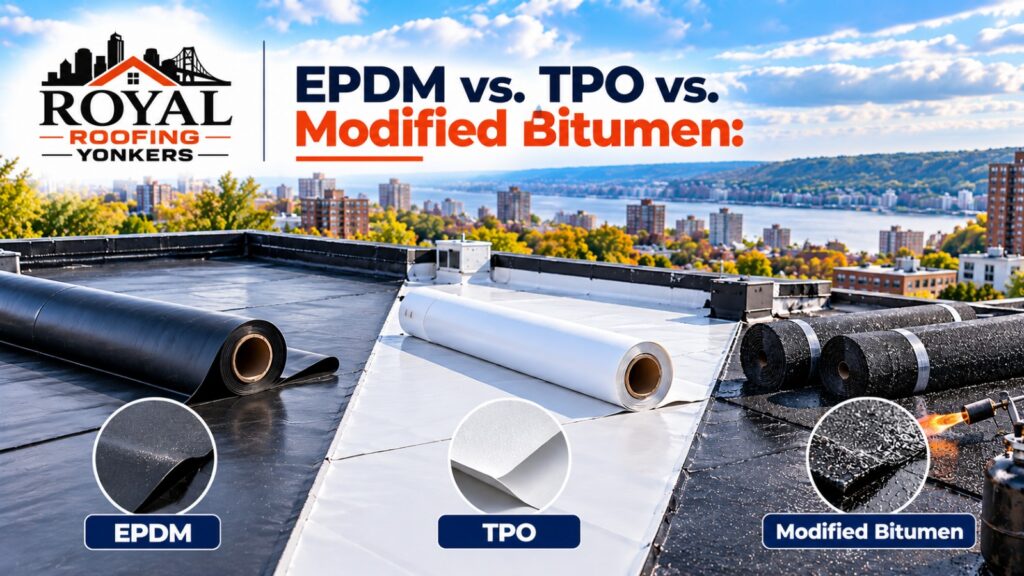
Quick Answer: EPDM, TPO, and modified bitumen are all established options for flat roofs in Yonkers, NY, but they solve roofing challenges differently.
EPDM is a flexible synthetic rubber membrane with strong weather and UV resistance. TPO is a thermoplastic membrane known for heat-welded seams and reflective white surfaces. Modified bitumen is a reinforced asphalt-based system available in SBS and APP configurations with several installation methods.
The right system depends on the roof’s drainage, deck, sun exposure, penetrations, roof traffic, and existing construction. This guide compares those performance characteristics rather than pricing.
Why Flat Roof Material Matters in Yonkers, NY
Low-slope roofing appears on more than commercial buildings in Yonkers.
Local flat-roof applications include apartment and multifamily properties, mixed-use buildings, schools, retail facilities, churches, and residential additions. Royal Roofing Yonkers specifically identifies low-slope roofs around areas including Getty Square, Bryn Mawr, and Lincoln Park, where roof use and drainage can differ substantially from pitched residential construction.
Yonkers Weather and Flat Roof Exposure
A low-slope membrane has to remain functional through cold winters, snow accumulation, melting ice, spring rainfall, summer heat, sunlight, and repeated temperature changes.
EPDM addresses movement through rubber flexibility. TPO combines thermoplastic flexibility with heat-welded seams and strong heat and UV resistance. SBS modified bitumen uses polymer-modified asphalt designed to retain flexibility and tolerate thermal movement.
These differences become important at seams, penetrations, perimeter flashing, and areas where the roof structure moves seasonally.
Drainage Challenges on Yonkers Flat Roofs
“Flat” roofs still require slope.
Water needs a designed path toward drains, scuppers, or another outlet. Ponding often develops where insulation has compressed, the deck has settled, debris blocks drainage, or previous work has altered the roof profile.
Membrane selection cannot correct inadequate drainage by itself. Drainage problems need to be addressed as part of the roof assembly.
Choosing Materials for Long-Term Performance
A useful comparison looks beyond one feature such as reflectivity or membrane thickness.
Long-term performance involves the membrane, seams, flashing, roof deck, drainage layout, insulation, rooftop activity, and maintenance history working together.
EPDM vs. TPO Roofing for Yonkers Flat Roofs
EPDM and TPO are both single-ply systems, but their chemistry and installation methods are different enough to affect how they are used.
What Is EPDM Roofing?
EPDM stands for ethylene propylene diene terpolymer. It is a synthetic rubber roofing membrane used extensively on low-slope roofs.
Carlisle describes EPDM as offering strong flexibility, elongation, UV resistance, and weather resistance. The material can expand and contract with building movement while remaining flexible over a wide range of conditions.
EPDM seams commonly use primers and pressure-sensitive seam tapes rather than hot-air welding.
Large membrane sheets can also reduce the number of field seams on broad uncomplicated roof areas.
What Is TPO Roofing?
TPO is a thermoplastic polyolefin single-ply membrane.
Its field seams are typically joined by hot-air welding. GAF describes its TPO membrane as having heat-welded seams, strong heat and UV resistance, and highly reflective white options.
White TPO can therefore be useful on roofs with substantial summer sun exposure where limiting solar heat absorption at the membrane surface is a priority.
EPDM vs. TPO in Yonkers Conditions
EPDM has a particular advantage where flexibility through temperature changes is important. Its rubber composition remains elastic as the building and roof assembly move.
TPO provides a different advantage at the seams. Properly executed heat welding creates a continuous thermoplastic joint rather than a taped seam.
For summer exposure, conventional black EPDM absorbs more solar radiation, while white TPO is designed to reflect a larger portion of sunlight. White EPDM options also exist, so membrane color should be considered separately from membrane chemistry.
Maintenance also differs. EPDM inspections focus heavily on taped seams, flashing, patches, and punctures. TPO inspections include welded seams, surface damage, penetrations, and perimeter details.
How Modified Bitumen Performs on Yonkers Flat Roofs
Modified bitumen provides a different type of roof assembly from either EPDM or TPO.
What Is Modified Bitumen Roofing?
Modified bitumen starts with asphalt that is modified with polymers and reinforced to create roofing sheets.
Two important families are SBS and APP. GAF describes SBS-modified bitumen as asphalt modified with styrene-butadiene-styrene, giving the membrane increased elongation and low-temperature flexibility.
Installation methods can include hot asphalt, cold adhesive, heat welding, mechanical attachment, and self-adhered systems depending on the membrane and assembly.
Yonkers Weather and Modified Bitumen Performance
SBS modified bitumen can be useful where seasonal movement and colder conditions make flexibility important.
The reinforced membrane structure also provides strong puncture and tear resistance, which can be useful on roofs that receive routine service access.
Surface configuration matters as well. Granulated or reflective cap sheets can alter UV exposure and surface temperature compared with exposed dark asphalt surfaces.
Modified Bitumen vs. Single-Ply Membranes
EPDM and TPO typically rely on one primary membrane layer, while modified bitumen systems can incorporate multiple reinforced asphaltic layers.
That layered construction can be useful around detailed roof layouts and areas with routine maintenance traffic.
The tradeoff is that the installation process and seam treatment differ from single-ply systems and need to be matched to the building and project conditions.
Yonkers Flat Roof Lifespan: EPDM, TPO, and Modified Bitumen
Exact lifespan numbers are less useful than understanding what causes a system to age prematurely.
EPDM Lifespan Considerations
EPDM has one of the longest track records among modern single-ply roofing membranes.
Its resistance to UV exposure and its ability to remain flexible are important long-term characteristics. Carlisle identifies weatherability and flexibility as core EPDM strengths.
Service life still depends heavily on seam condition, flashing, punctures, drainage, and installation quality.
TPO Lifespan Considerations
TPO membrane performance is closely connected to membrane specification and weld quality.
GAF emphasizes heat and UV resistance along with heat-welded seam strength in its TPO systems.
Routine inspections should pay particular attention to penetrations, welded areas, perimeter conditions, and damage caused by rooftop activity.
Modified Bitumen Lifespan Considerations
Modified bitumen combines reinforced sheets with asphalt-based waterproofing.
The roof surface can reveal useful aging clues such as worn granules, exposed asphalt, cracking, blisters, or deteriorating laps.
Systems with reflective or mineral surfacing also need the condition of that protective layer monitored over time.
What Shortens Flat Roof Service Life?
Poor drainage, neglected flashing, damaged penetrations, repeated foot traffic, trapped moisture, deteriorated insulation, and delayed repairs can reduce service life regardless of membrane family.
Installation quality remains especially important because many low-slope roof failures begin at transitions rather than in the middle of an undamaged membrane.
Drainage Performance for Flat Roofs in Yonkers
Drainage is one area where the comparison becomes much simpler: all three systems need it.
Why Proper Drainage Matters in Yonkers
Rainfall, melting snow, and thawing ice need to reach roof drains, scuppers, or designed perimeter outlets.
Low areas that hold water keep seams and flashings wet longer and can place additional stress on insulation and the roof deck.
Royal Roofing Yonkers highlights drainage as a central issue for its local flat roofing work.
EPDM and Water Exposure
EPDM creates an effective waterproof membrane when seams and flashings remain intact.
Recurring ponding still deserves investigation because prolonged water exposure can concentrate stress around seams, patches, penetrations, and depressed areas.
TPO and Drainage
TPO’s heat-welded seams provide strong water-resistant joints when properly installed.
Standing water does not become harmless simply because seams are welded. A recurring low spot needs its slope and drainage path examined.
Modified Bitumen and Drainage
Modified bitumen provides layered asphaltic waterproofing, but laps, flashing, and surface condition still need protection from chronic ponding.
Its heavier construction does not eliminate the need for positive drainage.
Heat and UV Performance of Yonkers Flat Roof Materials
Roof-surface temperatures can change significantly between winter and summer.
EPDM Under Summer Heat and UV Exposure
Traditional black EPDM absorbs solar heat, but the membrane itself has strong UV resistance.
Carlisle also produces white EPDM, demonstrating that reflectivity is not exclusive to thermoplastic systems.
For a specific building, membrane color should be evaluated together with insulation and roof exposure.
TPO and Reflective Roof Performance
Reflectivity is one of TPO’s most recognizable characteristics.
GAF describes white EverGuard TPO as highly reflective and emissive, while also highlighting long-term heat and UV resistance.
That makes TPO particularly relevant for broad exposed roof areas receiving direct summer sunlight.
Modified Bitumen Under Heat and Sun
Modified bitumen systems can use different surfacing strategies.
Dark asphalt surfaces absorb more solar heat, while mineral-surfaced or reflective cap sheets can alter surface performance. GAF offers modified bitumen assemblies with reflective surfacing options.
Seasonal Temperature Movement
Temperature swings produce expansion and contraction throughout the roof assembly.
EPDM accommodates movement through rubber elasticity. TPO relies on thermoplastic membrane performance and welded seams. SBS modified bitumen uses polymer modification to improve flexibility compared with conventional asphaltic roofing.
Which Flat Roof Material Fits Yonkers Two-Family Homes?
Two-family properties often have smaller low-slope sections than large commercial buildings, but those roofs can be highly detailed.
EPDM for Two-Family Homes
EPDM can work well on relatively open low-slope areas, including additions, porches, garages, and rear roof sections.
Large sheets can reduce field seams, while the membrane’s flexibility can accommodate ordinary structural movement.
TPO for Two-Family Homes
TPO can suit roofs with strong sun exposure where a white reflective surface is desirable.
Heat-welded seams can also be useful on layouts where contractors can access the membrane properly for welding and testing.
Modified Bitumen for Two-Family Homes
Modified bitumen can be practical for compact roofs with more detailing or regular service access.
Its reinforced construction is useful where puncture resistance and surface toughness are important considerations.
Matching the System to the Roof
For a two-family property, evaluate the actual drainage path, roof slope, deck condition, insulation, penetrations, parapets, rooftop access, and existing membrane before selecting a new assembly.
A roof with several vents and frequent maintenance access creates a different material decision from a broad uninterrupted residential addition.
Yonkers Flat Roof Maintenance by Material Type
Routine maintenance focuses on somewhat different details for each membrane.
EPDM Maintenance
Inspect taped seams, patches, penetrations, perimeter flashing, and the membrane surface for cuts or punctures.
Pay extra attention to paths used by technicians accessing HVAC or other rooftop equipment.
TPO Maintenance
Check welded seams, penetrations, flashing, roof edges, and surface damage.
On reflective roofs, dirt accumulation can also change how the surface performs under sunlight.
Modified Bitumen Maintenance
Inspect laps, flashing, blisters, cracks, worn granules, exposed asphalt, and areas where repeated foot traffic has affected the cap sheet.
Drainage Maintenance
Keep drains, strainers, scuppers, and drainage paths clear.
Debris accumulation can create a water problem on any of the three systems even when the membrane itself remains in good condition.
EPDM, TPO, or Modified Bitumen: Key Differences
| Factor | EPDM | TPO | Modified Bitumen |
| Material type | Synthetic rubber | Thermoplastic membrane | Reinforced modified asphalt |
| Flexibility | Excellent | Good | Strong, especially SBS |
| Typical seam method | Tape/adhesive | Heat-welded | Varies by system |
| UV resistance | Strong | Strong | Influenced by surfacing |
| Reflective options | Black and white membranes available | White reflective membranes common | Reflective cap sheets available |
| Surface toughness | Good | Good | Strong layered construction |
| Frequent roof traffic | Protection recommended | Protection recommended | Often well suited with proper assembly |
| Drainage requirement | Essential | Essential | Essential |
| Primary inspection focus | Seams, flashing, punctures | Welds, flashing, punctures | Laps, surfacing, flashing |
This is the useful midpoint of the comparison: no membrane dominates every category. EPDM has notable flexibility, TPO has welded seams and common reflective options, and modified bitumen offers reinforced layered construction. The roof’s priorities determine which strengths matter most.
How to Choose a Flat Roof for Yonkers Conditions
Material selection becomes easier when the inspection answers four practical questions.
How Does the Roof Drain?
Identify the existing slope, drains, scuppers, overflow points, and areas where water has historically remained after rain or snowmelt.
Correct drainage defects before expecting a new membrane to solve them.
How Much Sun Reaches the Roof?
A broad exposed roof may place greater value on a reflective surface.
A roof shaded by surrounding construction or configured differently may place more emphasis on another characteristic.
What Is Beneath the Existing Membrane?
Deck deterioration, wet insulation, old repairs, multiple layers, and failing flashing can change the appropriate installation method.
These conditions need to be identified before choosing a membrane simply because its surface characteristics look attractive.
Can the Existing System Be Repaired?
Material selection is not always the immediate next step.
If the membrane remains broadly serviceable and the failure is isolated, a targeted roof repair can sometimes address the problem without removing the full assembly.
When deterioration is widespread, seams or flashing have failed repeatedly, or the assembly needs drainage and insulation changes, a complete roof replacement creates an opportunity to correct those conditions together.
Final Comparison: Choosing the Right Flat Roof Material
EPDM is especially strong where flexibility, weather resistance, and established rubber-membrane performance are priorities.
TPO brings heat-welded seams, strong UV performance, and widely available reflective white surfaces.
Modified bitumen provides reinforced asphalt construction, several installation methods, and a layered assembly that can be useful on detailed or service-intensive roofs.
The appropriate choice for a Yonkers property comes down to which of those characteristics solves the actual roof’s needs. A Getty Square mixed-use building with equipment access, a Bryn Mawr multifamily property, and a low-slope residential addition in Crestwood can all benefit from different membrane characteristics even though each roof is low-slope.
Choosing a Flat Roof for Your Yonkers Property
EPDM, TPO, and modified bitumen each bring a different performance profile to Yonkers low-slope roofing.
EPDM emphasizes flexibility and proven weather resistance. TPO combines welded seams with reflective options and strong heat and UV performance. Modified bitumen uses reinforced asphalt construction and offers several installation approaches.
Before selecting a system, the roof should be evaluated for drainage, deck condition, insulation, flashing, penetrations, existing materials, and rooftop use.
Get Expert Help Choosing the Right Flat Roof Material for Your Yonkers Property
If your Yonkers property has an aging membrane, recurring ponding, failed seams, flashing deterioration, punctures, or a low-slope roof approaching replacement, Royal Roofing Yonkers can inspect the existing assembly and explain which roofing system fits its structure and exposure.
Call Royal Roofing Yonkers at 914-228-9588 or visit 72 Radford St, Unit 205, Yonkers, NY 10705 to schedule a professional flat roof assessment.
FAQs: Flat Roofing Materials in Yonkers
Is EPDM or TPO better for a flat roof in Yonkers?
EPDM offers excellent flexibility and proven weather resistance, while TPO provides heat-welded seams and commonly available reflective surfaces. The stronger option for a particular Yonkers roof depends on drainage, sunlight, roof traffic, insulation, penetrations, deck condition, and the configuration of the existing roofing system.
How long does an EPDM flat roof typically last?
EPDM has a long performance history and can provide multi-decade service when properly installed and maintained. Actual service life depends on membrane specification, seam and flashing condition, drainage, rooftop traffic, punctures, insulation, repairs, and exposure rather than being determined by one fixed lifespan number.
How does TPO perform during Yonkers summers?
TPO is designed for strong heat and UV performance. White TPO membranes are also highly reflective, which can reduce solar heat absorption at the roof surface. Actual building performance still depends on insulation, membrane specification, roof exposure, ventilation, and the condition of the complete roofing assembly.
Is modified bitumen suitable for Yonkers flat roofs?
Yes. Modified bitumen can work well on residential, multifamily, and other low-slope Yonkers roofs. SBS systems provide reinforced asphalt construction with good flexibility, while different application and surfacing options allow the assembly to be matched to drainage, roof traffic, exposure, and building conditions.
Which flat roof material handles ponding water best?
EPDM, TPO, and modified bitumen are waterproof roofing systems, but none should be used as a substitute for proper drainage. Recurring ponding should prompt an evaluation of roof slope, drains, scuppers, insulation, deck settlement, and previous repairs before the membrane is selected or replaced.
What is the best flat roof material for two-family homes?
EPDM can suit open residential low-slope areas, TPO can provide reflective performance and welded seams, and modified bitumen can work well on detailed or frequently accessed roofs. The choice should reflect the two-family property’s drainage, deck condition, sun exposure, penetrations, roof traffic, and existing roofing assembly.
How does Yonkers weather affect flat roofing materials?
Yonkers roofs experience winter cold, snow, melting ice, rainfall, summer heat, UV exposure, and repeated seasonal temperature changes. Those conditions affect membrane movement, seams, flashing, drainage, and surface temperatures. Proper installation, drainage design, and routine inspection help all three roofing systems perform reliably.