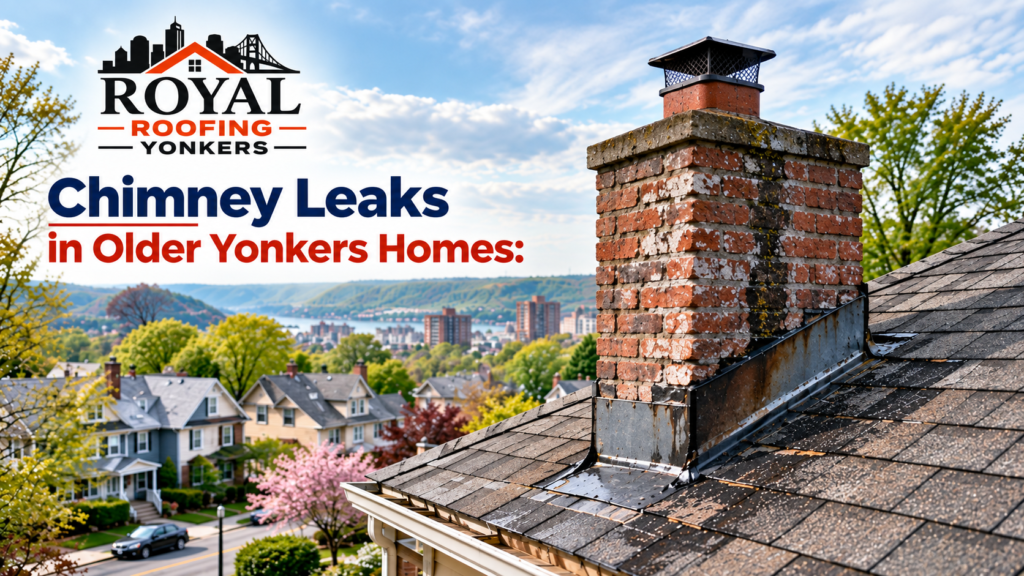
Quick Answer: Chimney leaks in Yonkers often begin at one of three connected areas: the flashing where the chimney meets the roof, the crown at the top of the masonry, or deteriorated mortar joints along the chimney walls.
A ceiling stain beside a chimney does not automatically mean the flashing is responsible. Water can enter through a crown crack or open masonry joint, move through the chimney structure, and appear near the roofline. Effective chimney leak repair in Yonkers therefore starts with inspecting the full chimney-to-roof connection.
Flashing controls roof runoff around the chimney. The crown sheds water from above. Sound mortar joints help prevent moisture from entering through the masonry. When more than one area has deteriorated, the repair needs to address those components together rather than relying on another layer of surface sealant.
Common Chimney Leak Points on Yonkers Roofs
A masonry chimney interrupts the normal path of water across a pitched roof. That makes the roof-to-chimney intersection one of the most detail-sensitive parts of the roofing system.
Water can enter through metal flashing at the roofline, damaged masonry above it, or crown defects much higher on the chimney.
Where Chimney Flashing Meets the Roof
Chimney flashing normally uses more than one metal component.
Base or step flashing integrates with the roofing and directs water away from the chimney. Counterflashing overlaps that lower metal from the masonry side so water cannot easily travel behind it.
Problems develop when metal pulls away, corrodes, develops holes, loses adequate overlap, or separates from the mortar joint.
The surrounding shingle roofing also matters because flashing needs to be integrated with the shingle courses rather than treated as an isolated patch sitting on top of them.
Sealant can protect specific joints, but it should support properly installed flashing rather than replace it.
Chimney Crown Edges Above Yonkers Rooflines
The crown is the sloped surface at the top of a masonry chimney.
Its job is to move rain away from the chimney walls. A properly formed crown projects beyond the masonry and prevents water from simply running directly down the brick.
Cracks, deteriorated edges, open areas around the flue, or sections that hold water can allow moisture into the chimney structure.
That moisture can travel downward through the masonry before appearing near the roof, which is why some apparent “flashing leaks” originate much higher on the chimney.
Masonry Joints Near the Roofline
Mortar joints immediately above the roof are exposed to rain, snowmelt, temperature changes, and roof runoff.
Cracked, recessed, loose, or missing mortar can create openings through the chimney wall.
The lower chimney deserves particular attention because counterflashing often enters or attaches around these masonry joints. If the mortar is deteriorated, even sound metal flashing can lose a reliable connection to the chimney.
How Yonkers Weather Can Expose Chimney-to-Roof Leaks
Some chimney leaks are obvious after nearly every rainfall. Others appear only during certain weather conditions.
That difference can provide useful clues during diagnosis.
Freeze-Thaw Cycles Around Chimney Masonry
Moisture absorbed into mortar or cracked masonry can freeze during cold weather.
As freezing and thawing repeat, already weakened joints can open further. Crown cracks can also enlarge as moisture repeatedly enters and freezes.
This matters at the roofline because movement in the masonry can affect the joints supporting counterflashing.
The result can be a leak that seems to appear suddenly even though the deterioration developed gradually.
Heavy Rain and Water Runoff at Chimney Bases
Rain moving down a pitched roof has to divide and travel around the chimney before continuing toward the gutters.
This concentrates water along the uphill and side sections of the chimney.
When back flashing, corners, or side flashing are damaged, heavy runoff can expose those weaknesses quickly.
Large chimneys may also require additional water-diversion detailing behind the uphill side depending on chimney width and roof design.
Wind-Driven Rain Around Flashing
Wind can push rain against vertical masonry instead of allowing water to fall only onto the roof surface.
That can expose small openings beneath lifted counterflashing or deteriorated mortar joints that remain dry during light rainfall.
A chimney that leaks only during storms from one direction can therefore still have a genuine flashing or masonry defect.
Diagnosing the Source of a Yonkers Chimney Roof Leak
The visible ceiling stain rarely gives a complete picture of where water entered.
Moisture can follow roof decking, rafters, nails, masonry surfaces, or insulation before appearing inside the living space.
A useful diagnosis looks at both exterior defects and interior moisture patterns.
Inspecting Flashing and Counterflashing
Check for lifted metal, rust, holes, open corners, separation from masonry, missing sections, and previous patches.
The inspection should also determine whether counterflashing still overlaps the lower flashing correctly.
Repeated roof cement or caulk around the chimney can sometimes make the original installation difficult to see. A thick surface patch may stop water temporarily while hiding metal that is already deteriorated underneath.
Checking the Chimney Crown for Cracks
Inspect the crown surface, perimeter edges, and areas surrounding the flue.
Look for cracks, missing sections, deteriorated corners, open joints, and surfaces that allow water to collect instead of draining outward.
Small isolated cracks can require a different repair from a crown that has extensive deterioration.
Examining Masonry Below the Chimney Cap
The full masonry surface from the crown to the roofline should be checked.
Warning signs include:
- missing or deeply recessed mortar
- cracked horizontal or vertical joints
- loose brick faces
- damp or stained masonry
- previous repairs separating from the original material
- failing joints around counterflashing
Particular attention belongs near the roof intersection because masonry and roofing details meet there.
Tracing Water From the Attic to the Ceiling
When the attic can be accessed safely, look for staining on decking, rafters, framing, or insulation near the chimney.
Water can travel away from the entry point before dripping.
| Interior or Exterior Symptom | Areas to Investigate |
| Leak mainly during wind-driven rain | Counterflashing, side flashing, open mortar |
| Moisture running down chimney wall | Crown and upper masonry |
| Wet roof deck beside chimney | Base flashing and counterflashing |
| Leak returns after repeated caulking | Original flashing construction |
| Moisture appears after snowmelt | Crown, flashing and chimney back |
| Dampness appears on several sides | Multiple entry points |
These patterns help guide the inspection, but the actual repair should follow confirmed physical defects.
Yonkers Chimney Flashing Repair: What Needs Attention
Chimney flashing repairs in Westchester can range from a localized correction to rebuilding the entire flashing assembly.
Repairing Damaged Base Flashing
Localized repair can be appropriate when most of the existing metal remains sound.
An isolated open seam or damaged corner is different from flashing that is rusted through or incorrectly integrated with the roof.
The goal is to restore the intended water path rather than simply cover a visible opening.
Replacing Failed Counterflashing
Counterflashing protects the upper edge of the roof flashing against the chimney.
When it pulls away from masonry or loses adequate overlap, water can move behind the metal.
Replacement can require opening the appropriate masonry joint, installing properly formed counterflashing, and restoring the joint around it.
If the surrounding mortar is deteriorated, the masonry should be repaired at the same time.
Sealing Flashing Seams and Roof Transitions
Sealants are useful at specific joints and transitions.
They become a problem when they are treated as a substitute for properly fitted metal.
A chimney surrounded by several generations of roof cement often needs closer inspection because the underlying flashing may no longer be doing its job.
When Flashing Replacement Is More Practical
Replacement becomes more practical when metal is perforated, extensively corroded, distorted, poorly installed, or failing in several locations.
A targeted roof repair around the chimney can allow the roofing and flashing to be rebuilt as one assembly without assuming that the entire roof requires replacement.
| Flashing Condition | Likely Repair Direction |
| Small gap with sound metal | Local correction may be possible |
| Open corner or seam | Repair after checking surrounding flashing |
| Rusted or perforated metal | Replacement usually makes more sense |
| Counterflashing loose from masonry | Repair masonry joint and flashing |
| Several failed sections | Rebuild flashing assembly |
| Flashing failure plus crumbling mortar | Coordinate roofing and masonry work |
Chimney Crown Repair Options for Yonkers Rooflines
Crown problems create a different water path from flashing failures.
That distinction is important because repeatedly repairing the roofline will not stop water entering through the top of the chimney.
Repairing Minor Crown Cracks
Small cracks can sometimes be repaired when the surrounding crown remains structurally sound.
The entire crown should still be inspected before treating one visible crack.
If the surface is breaking apart or separating around the flue, a small patch is unlikely to address the whole problem.
Rebuilding Severely Deteriorated Crown Edges
A crown with widespread cracks, missing sections, broken edges, or extensive deterioration can lose its ability to shed water effectively.
Rebuilding damaged portions restores the shape needed to move water away from the chimney walls.
The outer edge should project beyond the masonry so runoff does not simply wash down the brick face.
Improving Crown Water Shedding
A good crown directs water outward.
If the surface is flat, cracked, or shaped in a way that holds water around the flue, moisture can continue entering even after a roofline repair.
For that reason, crown repair should address both material deterioration and drainage shape.
Brick Repointing Near the Yonkers Roofline
Brick repointing near the roofline becomes necessary when mortar joints deteriorate enough to let water into the chimney wall.
Proper repointing removes failed mortar and replaces it with compatible material.
Identifying Failed Mortar Joints
Common signs include missing mortar, deep recession, cracks, powdering joints, open vertical joints, and mortar separating from the brick edges.
For older masonry, harder mortar is not automatically better.
National Park Service guidance on masonry repair emphasizes that replacement mortar should be compatible with the existing brick. Mortar that is substantially harder and less permeable than surrounding masonry can transfer stress into the brick itself.
Repointing Open Joints Around Chimney Masonry
Proper repointing removes deteriorated mortar until sound material is reached.
The prepared joint is then filled with compatible replacement mortar.
A thin surface coating over failing mortar is not equivalent to repointing and usually does not solve deeper joint deterioration.
Where counterflashing enters the masonry, masonry work and roofing repairs need to be coordinated carefully.
Preventing Water From Reaching the Roof Connection
Sound joints reduce moisture entry through the chimney wall.
However, repointing does not fix defective flashing or a failed crown.
The moisture source should be identified first so masonry repairs are not completed while water continues entering from another component.
When Flashing, Crown, and Masonry Repairs Overlap
One chimney can have several active defects.
That is especially common when a leak has been patched repeatedly without a full inspection.
Why One Chimney Leak Can Have Multiple Entry Points
A cracked crown can allow moisture into the top of the masonry while deteriorated counterflashing admits roof runoff near the bottom.
At the same time, open mortar joints can provide another path through the chimney wall.
Repairing one problem may reduce the leak without eliminating it.
Coordinating Repairs at the Roof-Chimney Intersection
The sequence of work matters.
Loose masonry should not be expected to hold new counterflashing. Newly installed flashing should not be damaged later by unnecessary masonry demolition.
| Combined Condition | Repair Coordination |
| Loose counterflashing + failed mortar | Repair joint and flashing together |
| Crown cracks + wet masonry | Stop crown entry and assess masonry |
| Flashing failure + damaged shingles | Rebuild roof transition together |
| Crown + mortar + flashing deterioration | Plan all three as one leak-control project |
Avoiding Temporary Leak Patches
Repeated caulking can hide the original problem.
When a leak returns after several surface patches, the next step should be diagnosis rather than another layer of sealant.
The goal is to find how water enters, where it travels, and which component is no longer functioning.
When to Call for Professional Chimney Leak Repair
A professional inspection becomes especially useful when visible defects or recurring water stains point toward the chimney-to-roof connection.
Water Stains Near a Chimney
Ceiling discoloration, damp roof decking, wet insulation, or staining along the chimney wall can indicate water entry.
The interior stain alone cannot tell you whether the crown, flashing, or masonry is responsible.
Visible Flashing or Masonry Damage
Loose flashing, rusted metal, crown cracks, missing mortar, deteriorated brick, or open joints near the roofline should be inspected before additional water reaches the roof structure.
Recurring Leaks After Previous Repairs
A leak that returns after several rounds of patching is a strong reason to reassess the complete chimney assembly.
The next inspection should include the crown, masonry, flashing, adjacent roofing, and visible interior moisture path instead of repeating the previous repair automatically.
Chimney Leak Repair for Yonkers Roof-to-Chimney Problems
Effective chimney leak repair in Yonkers starts with identifying the actual source of the leak instead of assuming every stain beside a chimney is a flashing problem.
Failed base flashing or counterflashing can allow roof runoff behind the transition. Crown cracks can introduce moisture from above. Deteriorated mortar joints can create additional paths through the chimney wall.
Sometimes one repair solves the issue. In other cases, flashing, crown, and masonry work need to be coordinated.
For older masonry, compatible repointing is particularly important. Replacement mortar should work with the existing brick while the actual moisture source is corrected.
A successful repair restores the chimney-to-roof connection as a complete water-shedding system rather than treating each visible crack independently.
Schedule a Chimney Leak Inspection in Yonkers
If you are seeing water stains near a chimney, loose or corroded flashing, crown cracks, deteriorated mortar near the roofline, or a leak that keeps returning after previous patching, Royal Roofing Yonkers can inspect the full chimney-to-roof connection and identify whether the problem involves flashing, masonry, the crown, adjacent roofing, or several areas together.
Call Royal Roofing Yonkers at 914-228-9588 or visit 72 Radford St, Unit 205, Yonkers, NY 10705 to schedule a professional chimney leak inspection and discuss the appropriate repair.
FAQs: Chimney Leaks in Yonkers Homes
What causes chimney leaks where the chimney meets the roof?
Common causes include separated or corroded flashing, failed counterflashing, open mortar joints, cracked chimney crowns, and deterioration where the masonry intersects the roof. More than one defect can exist at once, so a stain beside the chimney does not automatically mean flashing is the only source.
How much does chimney flashing repair cost in Westchester?
There is no single reliable Westchester-wide price for chimney flashing repair. The scope can range from correcting one flashing section to rebuilding base flashing and counterflashing with adjacent roofing or masonry work. Roof pitch, chimney size, access, corrosion, mortar condition, and surrounding roof damage all affect the final quote.
When does a chimney need crown repair?
A crown should be evaluated when it has cracks, open areas around the flue, deteriorated edges, missing material, or a surface that no longer sheds water effectively. Minor defects can sometimes be repaired, while extensive cracking or broken sections can require partial or complete crown rebuilding.
Can damaged mortar cause a roof leak around a chimney?
Yes. Open or deteriorated mortar joints can allow rain to enter the chimney wall and travel toward the roof intersection. Water can then appear beside the chimney even if some flashing remains intact. Mortar, crown, and flashing conditions should therefore be inspected together when diagnosing recurring leaks.
How does brick repointing near the roofline prevent leaks?
Repointing removes deteriorated mortar and replaces it with compatible material, closing water-entry paths through the masonry. Around a chimney, it also helps restore sound joints near counterflashing. Repointing works best when other moisture sources, including failed flashing or crown defects, are corrected at the same time.
Can chimney flashing be repaired without replacing the roof?
Often, yes. Localized chimney flashing can sometimes be repaired or replaced while the surrounding roof remains serviceable. The required scope depends on how the flashing is integrated with the roofing and whether nearby shingles, underlayment, decking, or masonry have deteriorated. Flashing failure alone does not automatically require full roof replacement.
How can I tell whether my Yonkers chimney leak is coming from the flashing or masonry?
The leak pattern provides clues, but the ceiling stain alone cannot identify the source. Flashing separation, crown cracks, open mortar joints, attic moisture, and the weather conditions that trigger the leak all need to be considered. Some chimney leaks involve more than one entry point and require coordinated repairs.