Quick Answer: Manhattan roof replacement cost in 2026 starts around 6–15 per square foot for flat roofing, 5–12 for asphalt, 10–20 for metal and 18–35+ for slate. Co-ops, condos and townhouses often move beyond basic square-foot pricing because access, rooftop equipment, terraces, drainage, parapets and occupied-building logistics expand the scope.
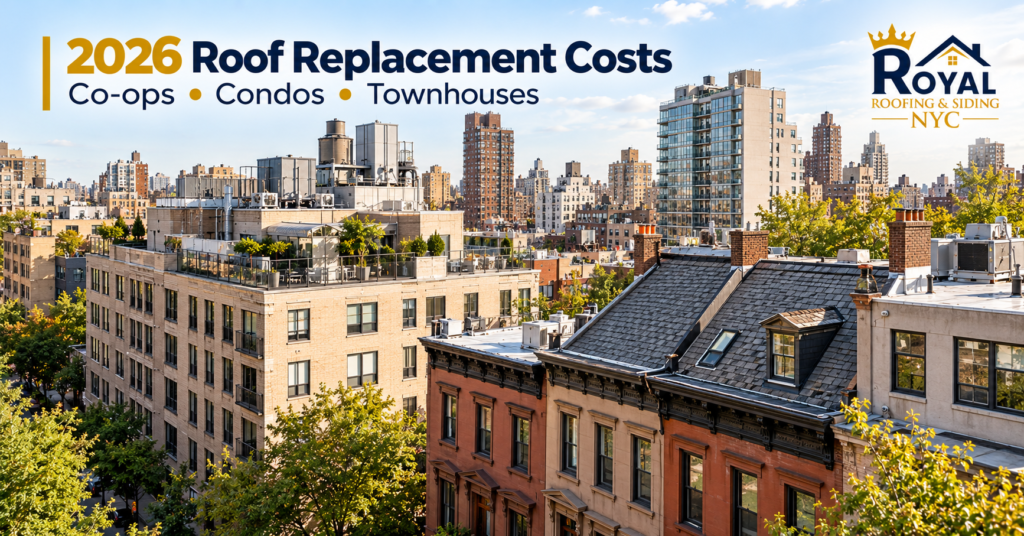
Replacing a roof in Manhattan rarely comes down to material and square footage alone. An Upper East Side townhouse, a Chelsea condominium and a large Upper West Side co-op create very different project conditions even when the exposed roofing area is similar.
Townhouses concentrate work around parapets, chimneys, skylights and party walls. Co-op and condo buildings add internal drains, bulkheads, rooftop equipment, common areas and occupied apartments. Taller properties also require more complicated material movement and staging.
Current figures from Modernize’s New York roofing cost guide provide a useful starting point, but Manhattan owners need to build the estimate around the complete roof assembly.
2026 Manhattan Roof Replacement Cost by Roofing Type
| Roofing system | Installed cost per sq. ft. | 1,000 sq. ft. | 2,000 sq. ft. | 5,000 sq. ft. |
| Asphalt shingles | 5–12 | 5,000–12,000 | 10,000–24,000 | 25,000–60,000 |
| Flat / low-slope roof | 6–15 | 6,000–15,000 | 12,000–30,000 | 30,000–75,000 |
| Metal roofing | 10–20 | 10,000–20,000 | 20,000–40,000 | 50,000–100,000 |
| Slate roofing | 18–35+ | 18,000–35,000+ | 36,000–70,000+ | 90,000–175,000+ |
These calculations show the roofing-material baseline. They do not include every Manhattan-specific condition such as extensive deck replacement, terrace removal, masonry work, equipment coordination or major drainage reconstruction.
Two 2,000-square-foot Manhattan roofs therefore produce very different proposals once building access and roof details enter the scope.
What New York City Roof Replacements Cost by Size
Modernize also provides New York City cost ranges by roof size, which give Manhattan owners a stronger local benchmark than statewide figures alone.
| Roof size | New York City replacement range |
| 1,500 sq. ft. | 11,500–18,500 |
| 2,000 sq. ft. | 14,500–25,500 |
| 2,500 sq. ft. | 18,500–33,000 |
A Manhattan property often lands above simple material calculations when the project involves high-rise access, extensive equipment, occupied apartments, terraces or older roof assemblies.
Flat roofs deserve particular attention because they dominate many Manhattan multifamily and townhouse properties. Modernize lists TPO or EPDM at 6,000–12,000 for 1,000 square feet, while premium PVC or comparable flat systems run around 8,000–15,000 for 1,000 square feet.
A flat roof involving decking or drainage repairs reaches roughly 12,000–22,000+ in the same New York pricing data.
Manhattan Roof Costs Change With the Building Type
| Property type | Common roof conditions | Major cost drivers |
| Co-op | Large low-slope roof, drains, bulkheads, equipment | Roof area, occupied-building work, drainage, equipment coordination |
| Condo | Low-slope roof, penthouses, terraces, mechanical systems | Terrace access, equipment, waterproofing transitions, common areas |
| Townhouse | Compact flat or pitched roof | Parapets, party walls, chimneys, skylights, masonry, limited access |
| High-rise residential | Large exposed roof with mechanical zones | Vertical access, equipment, staging, perimeter work, large drainage zones |
| Mixed-use property | Residential space above stores or offices | Tenant protection, deliveries, staging, temporary waterproofing |
Manhattan Co-op Roof Replacement Cost Is About Scale and Coordination
A large Manhattan co-op roof often combines broad membrane areas, parapets, several drains and mechanical equipment within one project.
A 5,000-square-foot flat roof produces a material-based planning range of 30,000–75,000 at 6–15 per square foot. Internal drains, equipment curbs, bulkheads, occupied apartments and concealed deck conditions raise the final figure where additional work is required.
Co-op boards also need enough detail in the proposal to separate routine roofing work from larger capital items. Tear-off, insulation, deck allowances, drainage, equipment flashing and temporary waterproofing all need defined scope.
A lower estimate that excludes drain work or concealed deck repairs does not represent the same project as one that includes those items.
Condo Roof Replacement Often Involves Terraces and Penthouses
Manhattan condos frequently use rooftop and setback areas for private terraces, penthouses and common amenities.
Those finished spaces add a separate cost layer above the membrane.
Pavers, decking, planters and railings often need controlled removal where they cover the replacement area. After waterproofing work is complete, the finished rooftop system needs reinstatement.
Door thresholds also require precise flashing because the exterior roof surface sits directly beside occupied penthouse interiors.
For condo boards, the estimate needs to separate membrane replacement from terrace removal and restoration so both the cost and responsibility remain clear.
Townhouse Roof Costs Depend Heavily on Roof Details
A townhouse has far less roof area than a large co-op, but smaller square footage does not automatically create a low-cost project.
Upper East Side, Upper West Side, Greenwich Village and Harlem townhouses often contain parapets, party walls, chimneys, skylights, hatches and older masonry within a compact roof.
Each transition adds labor.
A 1,000-square-foot flat townhouse roof produces a baseline of 6,000–15,000. Once decking or drainage repairs enter the scope, the New York flat-roof benchmark reaches roughly 12,000–22,000+.
Parapet or chimney masonry represents another separate condition. A new membrane does not correct deteriorated coping or open mortar joints beside it.
Slate Changes the Cost Picture on Historic Townhouses
Some Manhattan townhouses and older residential buildings contain pitched sections with slate.
Slate sits at the high end of current New York roofing costs at roughly 18–35+ per square foot.
That produces approximately 18,000–35,000+ for 1,000 square feet, 36,000–70,000+ for 2,000 square feet and 90,000–175,000+ for 5,000 square feet.
Most Manhattan townhouses do not contain 5,000 square feet of slate roofing, but the calculation shows how quickly premium materials change the replacement budget.
Chimneys, valleys, flashing, steep access and historic exterior details add further scope.
Vertical Access Is a Real Manhattan Cost Driver
A roofing material still needs to reach the roof.
On a townhouse, access often runs through a narrow interior stair, hatch or rear yard. On a larger co-op or condo, materials travel through service areas, freight routes or controlled roof-access points.
Taller buildings require a more deliberate plan for moving roofing materials upward and debris downward.
The estimate therefore needs to explain material handling rather than bury access inside one unexplained number.
Street conditions also matter because many Manhattan buildings sit directly beside busy sidewalks, entrances, parked vehicles and neighboring properties.
Conditions That Change the Final Price
Several roof conditions push a Manhattan project beyond the basic square-foot calculation.
Decking and insulation: Tear-off sometimes exposes wet insulation, deteriorated wood, damaged sheathing or older repair areas. Townhouses often show hidden damage near parapets, skylights, chimneys and drains, while multifamily roofs develop trouble around ponding zones and equipment.
Drainage: Internal drains, scuppers, leaders and roof slope all affect replacement cost. A new membrane does not solve recurring ponding when the underlying drainage condition remains unchanged.
Parapets and masonry: Many Manhattan roofs terminate against masonry walls. Cracked mortar, damaged coping and deteriorated brick often need separate work so the new roof-to-wall flashing has a sound surface.
Rooftop equipment: HVAC units, exhausts, pipes, hatches and supports interrupt the membrane. Each penetration adds flashing work and coordination during replacement.
A strong proposal states how these conditions are priced before demolition begins.
Cool-Roof Requirements Affect Low-Slope Replacement Cost
Most Manhattan co-op, condo and townhouse roofs discussed in this guide are low-slope systems.
Covered low-slope replacement work needs to meet applicable NYC cool-roof reflectance and thermal-emittance requirements under NYC Building Code Chapter 15.
That requirement affects the membrane or coating specification selected for qualifying roof areas and therefore belongs in the replacement budget.
For large Manhattan flat roofs, the roof finish is not only a material preference. Code performance requirements form part of the specification.
Complete Roof Replacement Brings Sustainable-Roof Requirements Into the Budget
A complete Manhattan roof project also needs to account for NYC sustainable-roof requirements where the law applies.
NYC Local Laws 92 and 94 cover new buildings, new roofs created through qualifying enlargements and existing buildings replacing an entire roof deck or roof assembly, subject to stated exclusions and site conditions.
Covered Sustainable Roofing Zones use green roofing, solar photovoltaic systems or a combination.
This distinction matters when comparing a localized membrane repair with full replacement. Replacing the entire roof deck or roof assembly represents a broader planning exercise.
On Manhattan buildings crowded with mechanical equipment, hatches and required access areas, the sustainable-roof layout needs coordination with the replacement design before construction.
How to Compare Manhattan Roof Replacement Estimates
Do not start with the final number. Start with the scope.
A strong proposal identifies roof area, tear-off, material system, insulation, deck allowances, flashing, drains, parapets, equipment penetrations, terrace work, access, debris removal, temporary waterproofing and exclusions.
For a townhouse, check whether chimney, coping and masonry work are included. For a condo, check terrace removal and reinstatement. For a co-op, check drains, equipment zones and concealed deck pricing.
Only after those items match does a direct price comparison become useful.
Repair or Replace?
One failed seam, flashing detail or isolated leak does not automatically justify complete roof replacement.
Repair remains appropriate when the surrounding membrane, deck and drainage remain dependable.
Replacement becomes more practical when leaks develop across several sections, insulation stays wet, patches multiply, decking deteriorates or drainage failures affect broad roof areas.
For co-op and condo boards, repair history often provides the clearest signal. Repeated spending across different areas points toward a larger system condition rather than one isolated failure.
Manhattan Roof Replacement Cost Starts With the Building
The same square footage does not create the same roofing project across Manhattan.
A co-op replacement revolves around large roof areas, drainage, equipment and occupied-building coordination. A condo adds terraces, penthouses and shared rooftop amenities. A townhouse concentrates cost around parapets, masonry, chimneys, skylights and restricted access.
Material price provides the starting number. The building determines the final scope.
For a detailed roof replacement assessment in Manhattan, contact Royal Roofing & Siding NYC at 212-457-1331, 605 W 42nd St PH1A, New York, NY 10036.
FAQs: Manhattan Roof Replacement Cost in 2026
How much does roof replacement cost in Manhattan in 2026?
Current New York roofing figures place asphalt around $5 to $12 per square foot, flat roofing around $6 to $15, metal around $10 to $20 and slate around $18 to $35 or more. Manhattan totals also depend on access, drainage, equipment, terraces, masonry and concealed deck conditions.
How much does a 2,000-square-foot roof cost in New York City?
Modernize lists a New York City replacement range of approximately $14,500 to $25,500 for a 2,000-square-foot roof. The final Manhattan price changes with roofing material, building type and project complexity.
How much does a 1,000-square-foot Manhattan flat roof cost?
At $6 to $15 per square foot, a 1,000-square-foot flat roof represents roughly $6,000 to $15,000. Modernize lists flat roofs with decking or drainage repairs around $12,000 to $22,000 or more.
Why does co-op roof replacement cost more than simple square-foot pricing?
Co-op projects often include internal drains, equipment curbs, bulkheads, large membrane areas, occupied apartments, vertical access, temporary waterproofing and concealed deck conditions that expand the scope beyond roofing material alone.
What adds cost to a Manhattan condo roof replacement?
Rooftop terraces, penthouses, pavers, planters, mechanical equipment, door thresholds, drainage and restoration of finished amenity areas all add work to a condo roof replacement.
Do cool-roof requirements affect Manhattan flat-roof replacement cost?
Covered low-slope replacement work needs roof surfaces that meet applicable NYC reflectance and thermal-emittance requirements. The membrane or coating specification therefore forms part of the material and installation budget.
Do NYC sustainable-roof requirements affect Manhattan roof replacement?
Covered projects replacing an entire existing roof deck or roof assembly fall under NYC sustainable-roof requirements, subject to exclusions and site conditions. The applicable Sustainable Roofing Zone uses green roofing, solar photovoltaic systems or a combination.