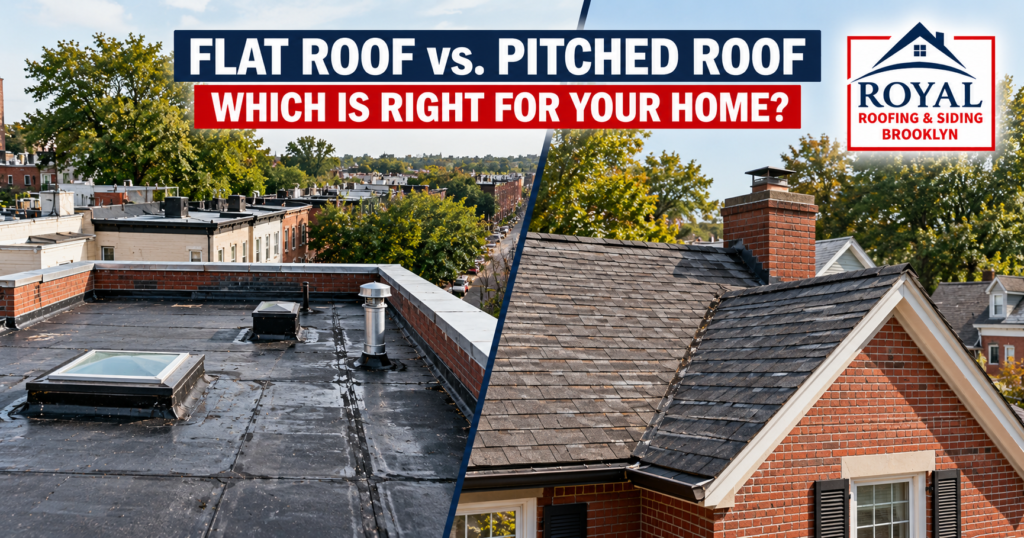
Quick Answer: In Brooklyn, the building usually determines whether a flat or pitched roof makes sense.
Brownstones and attached row houses in Brooklyn Heights, Park Slope, Fort Greene, Bed-Stuy, and Crown Heights commonly have low-slope roofs hidden behind masonry parapets. Detached houses in Ditmas Park and Victorian Flatbush are more likely to have steep pitched roofs with shingles, dormers, valleys, and sometimes turrets.
Many Brooklyn properties also have both. A house can have a pitched front roof with a low-slope rear section, or a pitched main house with a flat roof over a rear extension.
That means the most useful question is often not “Which roof is better?” but “What roof configuration already fits this building, its drainage, structure, neighborhood, and city requirements?”
Brooklyn weather matters too. Nor’easters affect parapets differently from pitched eaves, cloudbursts challenge flat-roof drainage, and coastal wind can affect both roof types in southern waterfront neighborhoods.
Brooklyn Roof Types by Neighborhood
Brooklyn’s housing stock makes a simple flat-versus-pitched comparison less useful than it would be in a neighborhood made up of one housing style.
The roof should be understood in the context of the property.
| Brooklyn Area | Common Roof Configuration | Important Roof Details |
| Brooklyn Heights, Park Slope, Fort Greene, Bed-Stuy, Crown Heights | Low-slope roofs behind parapets | Scuppers, internal drains, coping, party walls, bulkhead access |
| Ditmas Park / Victorian Flatbush | Steep pitched roofs | Dormers, turrets, valleys, shingles, gutters |
| Bay Ridge, Dyker Heights, Canarsie | Attached brick and frame houses | Roof edges, siding transitions, gutters, rear extensions |
| Williamsburg / Greenpoint | Large flat roofs and converted buildings | Decks, equipment, penetrations, drainage |
| Southern Brooklyn waterfront | Flat and pitched roofs | Wind exposure, edge metal, flashing, corrosion |
The roof type is therefore closely tied to the way that part of Brooklyn was built.
Brownstones and Attached Row Houses
On a typical attached brownstone, the roof is often low-slope even though it may look completely flat from the street.
Parapet walls conceal the roof surface, and drainage may leave through scuppers in the parapet or through internal drains rather than conventional eave gutters.
Roof access commonly comes through a hatch or bulkhead. Several roof-over layers may also be present on older buildings, hiding previous membranes or deck conditions below the visible surface.
Party walls create another Brooklyn-specific condition. A leak can develop along the adjoining roof edge or shared parapet instead of directly above the interior stain.
Victorian Flatbush and Ditmas Park
Detached houses in Victorian Flatbush and Ditmas Park create almost the opposite roofing environment.
Steep roof slopes, dormers, turrets, intersecting gables, valleys, chimneys, and gutters are common inspection and maintenance points.
This is where shingle roofing and some metal roofing applications fit naturally into the Brooklyn roof discussion.
The pitch helps water leave the roof quickly, but it also creates more roof area and more flashing transitions than a simple low-slope row-house roof.
Bay Ridge, Dyker Heights and Canarsie
These areas include many attached or semi-attached brick and frame homes.
The roof itself may be pitched, low-slope, or divided between several sections, while siding and exterior wall materials often meet the roof at additions, dormers, or upper-floor transitions.
For these properties, the roof-to-wall connection can matter as much as the main roofing surface.
Williamsburg and Greenpoint
Converted lofts, mixed-use buildings, and former industrial properties often have broad flat roofs.
Those roofs may carry HVAC equipment, decks, railings, pipes, exhausts, and other penetrations.
The roof field may look simple, but every rooftop element complicates drainage and waterproofing.
Many Brooklyn Homes Have Both Flat and Pitched Roofs
For many properties, “flat roof versus pitched roof” is not actually an either-or decision.
A Brooklyn house can contain two or three separate roof types installed at different times.
Pitched Front, Low-Slope Rear
A Park Slope house might have a pitched roof visible toward the front and a low-slope section over a rear extension.
Another property may have a pitched main roof with a flat porch, garage, or addition behind it.
The joint between these roof systems deserves special attention because water moving from the steeper section may concentrate where the pitched roof transitions onto the low-slope surface.
Flashing, drainage, and changes in elevation have to work together.
Rear Extensions Create Their Own Drainage Patterns
Rear additions are common across Brooklyn’s attached housing stock.
Their roofs may sit below the main building roof and collect water from adjoining walls or higher roof sections.
A low-slope rear roof can therefore receive more runoff than its own footprint suggests.
That drainage pattern should be understood before deciding how the roof should be repaired or replaced.
Mixed Roofs Need Mixed Maintenance
A homeowner may need gutters cleaned on the pitched section while also keeping scuppers clear on the flat section.
Likewise, shingles may need wind-damage checks while the low-slope section needs inspection around seams, parapets, and ponding areas.
Treating the whole property as one roof type can cause important details to be missed.
How Brooklyn Weather Treats Flat and Pitched Roofs Differently
Brooklyn weather creates different stress points depending on roof shape.
Nor’easters and Wind-Driven Rain
On a brownstone or row house, strong wind can push rain directly against parapet walls, coping joints, chimney masonry, and roof-to-wall flashing.
A low-slope membrane can remain intact while water enters through the vertical perimeter.
On pitched homes, strong wind acts more directly on shingles, ridge components, flashing, and eave edges.
A roof can therefore react very differently to the same nor’easter depending on its geometry.
Cloudbursts Challenge Flat-Roof Drainage
Short periods of extremely heavy rainfall can overwhelm scuppers and internal drains.
A flat roof that drains adequately during ordinary rain can still develop temporary ponding during an intense cloudburst, especially when leaves or storm debris partially restrict the outlet.
This makes drainage capacity and clear roof outlets especially important on Brooklyn row houses and multifamily buildings.
A pitched roof generally sheds rainfall faster, although gutters and downspouts can still overflow if they cannot handle the volume.
Freeze-Thaw at Parapets and Eaves
Winter creates different vulnerabilities.
On low-slope roofs, moisture entering parapet mortar or coping joints can freeze and expand. Repeated freeze-thaw cycles can enlarge those joints and create a leak path behind otherwise serviceable roofing.
Scuppers and drains can also freeze, causing meltwater to back up across the roof.
On pitched homes, snow and ice can remain around eaves, valleys, and shaded roof areas. Meltwater needs a clear route into gutters and downspouts.
Summer Heat on Low-Slope Roofs
Broad low-slope roofs can receive full sunlight for long periods during summer.
Dark roof surfaces absorb more heat, which can increase thermal stress on older seams, patches, coatings, and flashings.
That becomes relevant not only to roof performance but also to NYC’s current roof-reflectance requirements for applicable replacement work.
Waterfront Wind and Salt Exposure
Sea Gate, Manhattan Beach, Coney Island, Gerritsen Beach, and other waterfront areas experience greater exposure to coastal wind and salt-laden air.
On low-slope roofs, edge metal, coping, fasteners, and flashing deserve additional attention.
On pitched roofs, shingle edges, metal flashing, fasteners, and ridge components can also be more exposed.
The correct roof type does not eliminate those conditions; detailing and maintenance become more important.
NYC Rules Differ for Flat and Pitched Roofs
This is one area where roof slope has a direct regulatory effect.
The 2:12 Slope Matters for Roof Reflectance
New York City Building Code roof-reflectance standards use a 2:12 slope as an important dividing point.
Roofs or setbacks with slopes at or below 2 units vertical for every 12 units horizontal are subject to one set of reflectance standards, while steeper roofs are subject to different requirements.
For Brooklyn homeowners replacing a low-slope roof, membrane color or reflective surfacing may therefore be part of code compliance rather than just an appearance choice.
A pitched roof above that threshold is evaluated under the separate standard for steeper roof coverings.
Complete Roof Replacement Can Trigger Sustainable-Roof Requirements
Local Laws 92 and 94 require sustainable roofing zones for qualifying projects.
When an existing building replaces the entire roof deck or roof assembly, applicable roof area generally must be provided with solar photovoltaic panels, a green roof, or a combination of the two, subject to the law’s exceptions.
These requirements are different from an ordinary localized roof repair.
The law also treats roofs differently depending on slope and available qualifying roof area.
Before planning a full Brooklyn roof replacement, the actual project scope should be checked against current DOB requirements rather than assuming the same rule applies to every repair.
Historic Districts Add Another Layer
Brooklyn Heights, Park Slope, Fort Greene, and several other Brooklyn neighborhoods contain designated historic districts.
Most exterior alterations to buildings in these districts require Landmarks Preservation Commission review, while ordinary maintenance is treated differently.
Changing a visible roof form can be especially significant.
A new pitched roof, rooftop addition, visible bulkhead, altered cornice, or other major exterior change may require LPC review even when the underlying reason for the work is roofing-related.
Can You Convert a Flat Brooklyn Roof to a Pitched Roof?
Technically, it can be possible on some buildings. Practically, it is much more involved than selecting another roofing product.
Changing from a flat roof to a pitched roof changes the structure and shape of the building envelope.
That can affect framing, height, drainage, loads, zoning, adjoining walls, fire separation, and the building’s approved plans.
Most construction of this type requires Department of Buildings filings prepared by an appropriate registered design professional.
On an attached row house, the new roof form also has to work with party walls and adjoining structures.
For a property in a historic district, changing the visible roof form can require Landmarks Preservation Commission approval as well.
The reverse conversion, from pitched to flat, raises similar structural and regulatory questions.
For most Brooklyn homeowners, maintaining the roof form that already belongs to the building is far simpler than converting it unless there is a strong design or structural reason.
Flat Roof vs. Pitched Roof Maintenance in Brooklyn
The maintenance requirements are different, but neither roof type is maintenance-free.
| Inspection Area | Low-Slope / Flat Roof | Pitched Roof |
| Drainage | Scuppers, internal drains, ponding | Gutters, downspouts, valleys |
| Perimeter | Parapets, coping, wall flashing | Eaves, rakes, ridge details |
| Surface | Seams, patches, punctures, coatings | Shingles, metal panels, fasteners |
| Weather concern | Ponding, parapet leaks, heat | Wind lift, branch impact, eave ice |
| Typical access | Hatch or bulkhead | Exterior ladder or steep-roof access |
| Attached-building issue | Party walls, shared parapets | Roof-to-wall and addition transitions |
| Rooftop use | Decks, HVAC, penetrations | Usually more limited |
Flat Roof Maintenance
Low-slope Brooklyn roofs depend heavily on drainage.
Scuppers, drains, roof edges, parapet joints, and penetrations should remain clear and watertight.
A small drainage problem can affect a large portion of the roof if water has nowhere else to go.
Pitched Roof Maintenance
Pitched roofs shed water more quickly, but valleys, flashing, shingles, ridge areas, and gutters still require inspection.
Tree-lined detached neighborhoods also add the risk of falling branches and leaf accumulation.
Mixed Roof Maintenance
A home with both roof types needs both maintenance approaches.
The transition between the pitched and low-slope sections should also be inspected because it can receive concentrated runoff and experience movement between different roofing assemblies.
How Cost Differs Between Flat and Pitched Brooklyn Roofs
Cost should not decide the roof shape because most Brooklyn homeowners already have a building designed for one configuration or a combination of both.
A flat brownstone roof can be relatively small yet expensive to work on because of bulkhead access, parapets, roof-over layers, masonry, drainage, and limited staging.
A pitched Victorian Flatbush roof may provide easier exterior access but have considerably more surface area, steep slopes, dormers, turrets, and valleys.
The more useful comparison is the cost of correctly maintaining or replacing the roof system that fits the building rather than trying to choose whichever roof type appears cheaper online.
Which Roof Type Makes Sense for Your Brooklyn Property?
For most homeowners, the existing building already answers most of the question.
Brownstones and attached row houses usually function best with the low-slope configuration built into their parapet and drainage design.
Victorian Flatbush and Ditmas Park houses generally rely on pitched roofs that suit their dormers, gables, turrets, gutters, and architectural form.
Bay Ridge, Dyker Heights, and Canarsie properties often require closer attention to how roof sections meet siding, brick walls, gutters, garages, and additions.
Williamsburg and Greenpoint conversions typically depend on flat-roof systems capable of handling rooftop decks, equipment, and multiple penetrations.
Southern waterfront properties need either roof type detailed for stronger wind exposure and more aggressive conditions around exposed metal.
The most important choice is usually not changing the roof shape. It is making the existing roof configuration work correctly for the building.
Choosing Between Flat and Pitched Roofing in Brooklyn
Brooklyn is not a place where one roof style can be recommended across the borough.
Brownstones and attached row houses depend on low-slope roofs, parapets, scuppers, party walls, and roof-hatch access. Victorian Flatbush homes depend on pitched roofs, dormers, valleys, and gutters. Many properties use both roof types, especially where rear additions were added behind an older main building.
Brooklyn weather reinforces those differences. Nor’easters drive rain into parapet details, cloudbursts test low-slope drainage, freeze-thaw affects masonry and outlets, and coastal wind places more pressure on roof edges and fasteners.
NYC rules also treat roofs differently based on slope and project scope.
Get Professional Help Evaluating Your Brooklyn Roof
If you are planning roof repair, roof replacement, or work on a property with both pitched and low-slope sections, Royal Roofing & Siding Brooklyn can inspect the existing roof configuration and explain what the building needs without forcing it into the wrong roofing category.
Call 718-536-2667 to request a free consultation and roof evaluation.
Royal Roofing & Siding Brooklyn
108 Emerson Pl Suite 212, Brooklyn, NY 11205, United States
FAQs: Flat Roof vs. Pitched Roof for Brooklyn Homes
Are flat roofs common on Brooklyn brownstones?
Yes. Many Brooklyn brownstones and attached row houses use low-slope roofs enclosed by masonry parapets. Water may leave through scuppers or internal drains rather than eave gutters, and access often comes through a roof hatch or bulkhead. These conditions make flat-roof drainage and parapet maintenance especially important.
Where are pitched roofs most common in Brooklyn?
Pitched roofs are especially common on detached and semi-detached houses in places such as Ditmas Park, Victorian Flatbush, Marine Park, and Mill Basin. These roofs can include shingles, dormers, gables, turrets, valleys, chimneys, and conventional gutter systems that differ significantly from brownstone low-slope roofing.
Can a Brooklyn house have both a flat and pitched roof?
Yes. Many Brooklyn properties combine roof types. A home may have a pitched main roof with a low-slope rear extension, or a pitched front section connected to a flat rear roof. The transition between those systems needs careful flashing and drainage because runoff from the higher roof can concentrate below.
Which roof type handles Brooklyn storms better?
Neither roof type is automatically better in every storm. Low-slope roofs depend heavily on clear scuppers, drains, parapets, and perimeter flashing during heavy rain. Pitched roofs shed water faster but can experience wind-lifted shingles, branch impact, and eave or gutter problems during severe weather.
Do NYC roof rules differ for flat and pitched roofs?
Yes. NYC roof-reflectance standards distinguish between roofs at or below a 2:12 slope and steeper roofs. Sustainable-roof requirements can also apply to qualifying full roof-deck or roof-assembly replacement projects, so the roof slope and exact scope should be reviewed before major replacement work begins.
Can I change a flat Brooklyn roof into a pitched roof?
A roof-form conversion may be possible on some properties, but it is structural alteration work rather than a normal roofing-material change. It can require engineering or architectural plans, DOB filings, structural changes, and review of zoning and adjoining-building conditions. Historic-district properties can also require LPC approval for exterior changes.
Is a flat roof cheaper to maintain than a pitched roof in Brooklyn?
Not necessarily. Flat roofs may require more attention to drainage, parapets, seams, rooftop equipment, and ponding, while pitched roofs require monitoring of shingles, valleys, flashing, gutters, and steep sections. Brooklyn access conditions, building type, weather exposure, and roof complexity influence maintenance more than roof shape alone.