Quick Answer: Manhattan roof maintenance changes with the building. High-rises need close attention to wind-exposed perimeters, equipment and access; co-ops depend on organized inspections, drainage and capital planning; townhouses need focused care around parapets, chimneys, skylights and older roof-to-wall connections.
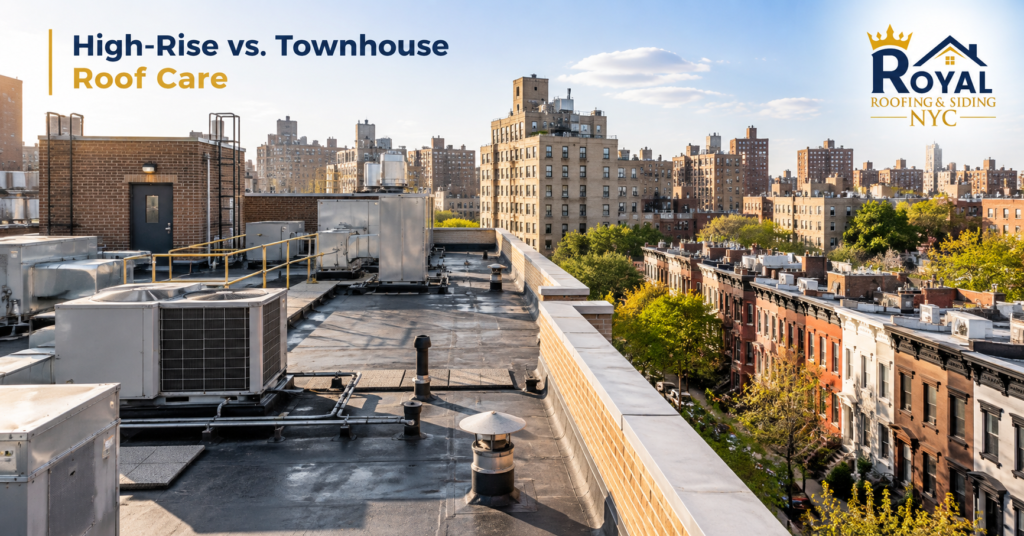
Manhattan compresses very different buildings into the same blocks. A Midtown tower, an Upper West Side co-op and an Upper East Side townhouse all face rain, snow, summer heat and freeze-thaw cycles, but their roofs do not experience those conditions in the same way.
A high-rise roof sits above stronger wind exposure and often supports extensive mechanical equipment. A co-op roof operates under a shared ownership structure where maintenance records, budgets and scheduled work affect the entire building. A townhouse roof covers a smaller area but often connects to aging masonry, chimneys, parapets, skylights and neighboring walls.
The strongest maintenance strategy starts with those differences instead of applying one checklist to every Manhattan property.
Manhattan Roof Maintenance by Building Type
| Maintenance factor | High-rise | Co-op building | Townhouse |
| Typical roof environment | Exposed low-slope roof at significant height | Low-slope roof on pre-war or postwar multifamily property | Compact low-slope or pitched roof |
| Main concerns | Wind exposure, equipment, penetrations, perimeter details | Drainage, membrane condition, shared equipment, long-term planning | Parapets, chimneys, skylights, party walls |
| Drainage | Internal drains and overflow systems | Internal drains, scuppers and roof slope | Scuppers, leaders, gutters or small drains |
| Access | Controlled roof access and service routes | Managed access through common areas | Narrow stairs, hatches or rear-yard access |
| Maintenance planning | Engineering and building-operation coordination | Board budgeting, documentation and scheduled projects | Direct owner decisions and localized repairs |
| Exterior-wall connection | Parapets and high-rise façade interfaces | Parapets, coping and masonry | Party walls, parapets, chimneys and cornices |
Manhattan High-Rise Roofs Face Greater Exposure
High-rise roofs in Midtown, the Financial District and other dense Manhattan districts sit in a very different environment from roofs closer to street level.
Height increases exposure around roof edges, penthouses, mechanical equipment and other rooftop structures. Wind-driven rain also reaches vertical transitions and perimeter flashing from directions that ordinary rainfall does not.
Maintenance therefore needs to focus heavily on attachment, flashing and roof-edge conditions.
Roof Perimeters Need Close Attention
The perimeter represents one of the most exposed parts of a high-rise roof.
Membrane terminations, coping, edge metal and flashing need to remain secure. Movement or separation along these details introduces a path beneath the roof covering.
A small perimeter defect deserves attention before repeated high-wind events enlarge it.
High-rise inspections therefore need a deliberate review of the complete roof edge rather than an inspection focused only on the central membrane field.
Mechanical Equipment Creates Dense Maintenance Zones
Manhattan towers often use valuable rooftop space for mechanical and building-service equipment.
HVAC units, exhaust systems, cooling equipment, conduits, pipes, vents, antennas and service supports create numerous waterproofing transitions.
Maintenance activity also concentrates around those zones. Technicians walk the same routes, open access panels and work around curbs and penetrations throughout the year.
Roof inspections need to identify worn membranes around service paths, damaged curb flashing, loose sealant and changes made during mechanical work.
A roof with extensive equipment requires coordination between roofing maintenance and building operations.
High-Rise Drainage Needs Routine Review
Large low-slope roofs often depend on internal drains and overflow routes.
One obstructed drain creates ponding across a significant section of roof. Debris around strainers, damaged flashing, settled insulation or a local low point changes how quickly water leaves the surface.
Drain maintenance therefore needs to happen before heavy seasonal rainfall rather than after ponding appears.
The inspection also needs to record areas where water repeatedly remains after storms. A recurring low point often signals a slope or substrate condition rather than simple surface debris.
Co-op Roof Maintenance Is Also a Management Strategy
A co-op is an ownership structure rather than one specific building form. A Manhattan co-op often occupies a pre-war apartment building, a postwar tower or another multifamily property with a shared roof.
That distinction matters.
Roof maintenance affects every shareholder, while decisions about repairs, inspections and replacement pass through a board or building-management process. Technical roof condition and long-term capital planning therefore need to stay connected.
Inspection Records Matter More on Shared Buildings
A co-op benefits from consistent roof records.
Inspection reports, leak locations, repair dates, photographs, drain problems and membrane work create a history that helps the board distinguish an isolated defect from a recurring pattern.
Without that record, the same location often receives repeated repairs without a clear view of the underlying problem.
A documented maintenance history also improves replacement planning because the board sees where money has already been spent and which sections continue to deteriorate.
Drainage Problems Affect Multiple Apartments
A drainage defect on a multifamily roof rarely stays confined to one ownership area.
Water entering near a drain or parapet travels through insulation, deck assemblies and interior partitions before becoming visible. Top-floor stains in separate apartments often trace back to one roof condition.
For that reason, co-op maintenance needs a roof-wide approach.
The inspection needs to review drain locations, ponding patterns, membrane seams, penetrations, parapets and bulkheads together instead of treating each interior complaint as an unrelated repair.
Capital Planning Prevents Emergency Replacement Decisions
A co-op roof represents a shared building asset.
Waiting until widespread leakage appears forces the board into a larger decision under time pressure. Regular condition reviews give the building a clearer picture of remaining service, developing defects and future replacement scope.
That process also helps separate routine maintenance from capital work.
Cleaning drains, repairing one flashing detail and correcting a limited membrane defect belong to ongoing maintenance. Widespread membrane deterioration, wet insulation and extensive deck work point toward a larger replacement project.
High-Rise Co-ops Need Both Strategies
Some Manhattan properties fit both categories.
A high-rise co-op needs the technical maintenance strategy of a tall building and the organizational strategy of shared ownership.
The roof still faces high wind exposure, equipment, drains and perimeter conditions, while the board also needs inspection records, repair history, budgeting and long-range planning.
Treating “high-rise” and “co-op” as identical terms misses this difference. One describes the physical building; the other describes how decisions and responsibility are organized.
Manhattan Townhouses Concentrate Risk Into a Smaller Roof
Townhouse roofs are much smaller than tower roofs, but smaller does not mean simpler.
Upper East Side, Upper West Side, Harlem and Greenwich Village townhouse blocks contain attached buildings where the roof meets parapets, party walls, chimneys, skylights and older masonry within a compact area.
A single failed transition therefore affects a large percentage of the roof.
Parapets and Party Walls Need Regular Inspection
Townhouse roofs often terminate against masonry rather than open eaves.
Mortar joints, coping and flashing age differently from the roof membrane. A sound membrane still develops leaks when water enters through deteriorated masonry beside it.
Party-wall transitions add another complication. Neighboring roofs often sit at slightly different elevations or receive replacement work at different times.
Maintenance needs to follow the full roof-to-wall connection instead of stopping at the visible membrane.
NYC also requires annual observation of parapets fronting a public right-of-way, regardless of building height, subject to stated exemptions. The NYC parapet requirements therefore have direct relevance to many Manhattan townhouse and multifamily properties.
Chimneys and Skylights Create Compact Leak Zones
Townhouse roofs often contain several vertical penetrations within a small roof area.
A chimney, skylight, hatch or vent interrupts the waterproofing surface and creates flashing corners that require periodic inspection.
Leaves and debris also gather behind some of these projections, slowing drainage and holding moisture against flashing.
Maintenance needs to keep these transition zones clear and watertight.
Manhattan Townhouses Also Bring Historic-Building Constraints
Upper East Side, Upper West Side, Harlem and Greenwich Village include many older townhouse blocks where rooflines, cornices, skylights and exterior masonry contribute to the building’s architectural character.
Many of these blocks sit inside LPC-designated historic districts, where visible changes to rooflines, cornices, skylights and street-facing masonry require Landmarks Preservation Commission review before work begins. Owners confirm the property’s status on LPC’s historic district map before planning visible exterior work.
Older Buildings Need More Attention to Previous Repairs
A Manhattan townhouse often carries several generations of roofing work.
Old membrane, coatings, flashing patches and masonry repairs create a layered history. One section often looks newer than another because earlier owners addressed leaks individually rather than replacing the complete system.
Maintenance inspections need to identify these repair zones and track whether the same areas continue to fail.
A growing collection of patches signals a different maintenance problem from one isolated repair.
Drainage Strategy Changes Across Manhattan Roof Types
| Building | Primary drainage concern | Maintenance priority |
| High-rise | Internal drains serving large roof areas | Keep outlets clear and track recurring ponding |
| Co-op | Shared drainage affecting multiple units | Maintain records and review the entire drainage pattern |
| Townhouse | Compact scuppers, leaders or drains | Remove debris and inspect wall connections around outlets |
| Pitched townhouse | Gutters, valleys and downspouts | Keep runoff routes open and inspect roof edges |
Drainage maintenance deserves special attention because water follows gravity regardless of ownership structure or roof material.
The important question is how each building moves water from the roof to the drainage system.
Façade Conditions Matter on Taller Manhattan Buildings
Roof maintenance on a tall building does not stop exactly where the membrane ends.
Parapets, coping and exterior-wall appurtenances sit directly beside the roof and often share flashing connections.
Under NYC’s Façade Inspection & Safety Program, owners of buildings higher than six stories need exterior walls and appurtenances inspected every five years by a Qualified Exterior Wall Inspector, with a technical report filed through DOB NOW: Safety. The NYC Department of Buildings FISP guidance outlines the current filing requirements.
Roof maintenance and façade maintenance remain separate scopes, but coordination between them is valuable. A parapet or wall defect beside sound roofing still creates a path for moisture at the roof edge.
Maintenance, Repair and Replacement Are Different Stages
Routine maintenance keeps drains clear, checks membrane condition, reviews flashing and tracks developing defects.
Repair begins once an inspection identifies a failed component such as drain flashing, a separated seam, deteriorated coping or damaged curb flashing.
Replacement becomes more practical when leaks develop across several roof areas, repairs keep returning, insulation remains wet, decking deteriorates or widespread membrane failure shows that localized work no longer addresses the full condition.
Maintenance records make that transition easier to identify. A townhouse owner sees when patches begin multiplying across a compact roof, while a co-op board sees repair costs and leak reports increasing over several inspection cycles.
Different Manhattan Roofs Need Different Maintenance Plans
Manhattan high-rises, co-ops and townhouses experience the same city weather through very different roof systems.
High-rises need strong perimeter, equipment and drainage maintenance. Co-ops need consistent inspections, documentation and long-term planning in addition to technical roof care. Townhouses need close attention to parapets, party walls, masonry, chimneys, skylights and compact drainage.
The strongest maintenance plan follows the building rather than a generic checklist.
For professional roof maintenance, inspection, repair or replacement planning in Manhattan, contact Royal Roofing & Siding NYC at 212-457-1331, 605 W 42nd St PH1A, New York, NY 10036.
FAQs: Manhattan Roof Maintenance for High-Rises, Co-ops and Townhouses
Why do Manhattan high-rise roofs need different maintenance?
High-rise roofs face stronger exposure around roof perimeters and contain extensive mechanical equipment, penetrations and internal drainage. Maintenance needs to focus on edge attachment, equipment flashing, service areas, drains and recurring ponding.
How is co-op roof maintenance different from regular apartment-building maintenance?
A co-op combines technical roof care with shared decision-making. Inspection records, leak history, repair documentation, budgeting and long-term replacement planning help the board manage the roof as a shared building asset.
What roof areas need the most attention on a Manhattan townhouse?
Townhouse maintenance needs close attention at parapets, coping, party walls, chimneys, skylights, hatches, previous patches and compact drainage outlets. These transitions often develop problems before the central roof field.
Do Manhattan townhouse parapets require annual observation?
NYC requires annual observation of parapets fronting a public right-of-way regardless of building height, subject to the city’s stated exemptions. The observation focuses on identifying unsafe parapet conditions.
Does FISP apply to Manhattan high-rise buildings?
NYC’s Façade Inspection & Safety Program applies to buildings higher than six stories. Exterior walls and appurtenances receive inspection every five years by a Qualified Exterior Wall Inspector, with a technical report filed with the Department of Buildings.
How often does a Manhattan roof need maintenance inspections?
A consistent spring and fall inspection schedule gives owners and managers a practical baseline for checking drainage, flashing, membrane condition, parapets and rooftop equipment, with additional inspection after significant weather or rooftop work.
When does maintenance turn into roof replacement?
Replacement becomes more practical when leaks develop across several areas, repairs keep returning, insulation stays wet, decking deteriorates or widespread membrane failure shows that localized work no longer addresses the complete roof condition.