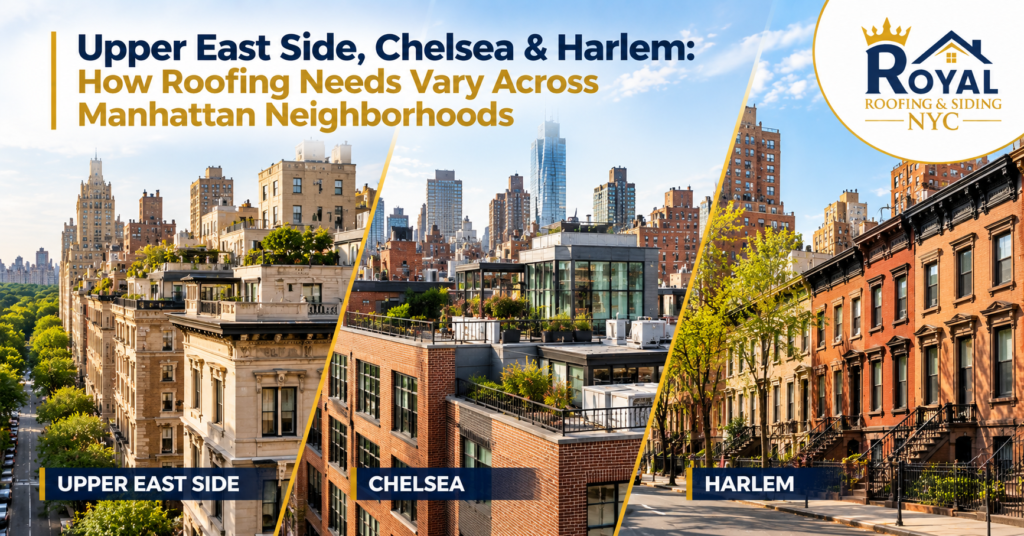
Quick Answer: Manhattan roofing needs change sharply between neighborhoods. Upper East Side properties combine townhouses, co-ops and towers; Chelsea adds loft conversions, mixed-use buildings and rooftop terraces; Harlem brings extensive row-house blocks, pre-war multifamily roofs and older masonry details.
Manhattan looks compact on a map, but its roof conditions change block by block. The Upper East Side combines narrow historic townhouses with large pre-war co-ops and newer apartment towers. Chelsea mixes nineteenth-century row houses and tenements with former loft and manufacturing buildings, mixed-use properties and rooftop amenity spaces. Harlem contains long row-house streets, brownstone façades, walk-ups and larger pre-war apartment buildings.
Those differences affect far more than roofing material. Roof size, parapets, drainage, rooftop equipment, historic-district status, occupied spaces and access routes all change from one neighborhood to another.
A maintenance or repair plan that fits an Upper East Side co-op does not automatically fit a Chelsea loft building or a Harlem row house. The building type and neighborhood context need to shape the roofing strategy from the beginning.
How Roofing Conditions Differ Across These Manhattan Neighborhoods
| Roofing factor | Upper East Side | Chelsea | Harlem |
| Common building mix | Townhouses, pre-war co-ops, apartment towers | Row houses, tenements, loft buildings, mixed-use properties | Row houses, brownstones, walk-ups, pre-war multifamily buildings |
| Common roof conditions | Low-slope co-op roofs, townhouse roofs, mechanical zones | Broad flat roofs, roof decks, loft penetrations, mixed-use roofs | Compact row-house roofs, parapets, chimneys, larger apartment roofs |
| Main water-entry areas | Parapets, equipment curbs, drains, townhouse flashing | Bulkheads, drains, terrace details, roof additions, penetrations | Parapets, party walls, coping, chimneys, scuppers |
| Access concern | High-rise access and occupied co-ops | Dense mixed-use blocks and active businesses | Attached buildings and narrow row-house access |
| Historic-building concern | Townhouse blocks and designated districts | Chelsea Historic District and older row-house blocks | Multiple historic districts and intact row-house streetscapes |
Upper East Side Roofing Ranges From Townhouses to Large Co-ops
The Upper East Side does not have one dominant roof condition.
Side streets contain attached townhouses with compact roofs, masonry parapets, chimneys and skylights. Park Avenue and surrounding avenues contain large pre-war co-ops with broad low-slope roofs, internal drainage and mechanical equipment. Taller residential buildings introduce stronger wind exposure and more complex service areas.
That variety makes building identification the first step in any roofing plan.
Townhouse Roofs Depend on Perimeter Details
An Upper East Side townhouse often has a relatively small roof, but much of that roof sits close to a parapet, party wall, chimney or skylight.
That concentrates risk around the perimeter.
Mortar joints, coping, flashing and neighboring roof elevations all affect water entry. A membrane across the center of the roof remains dependable only when these adjoining details stay watertight.
Townhouse inspections therefore need to spend as much time at masonry transitions as on the visible roof field.
Upper East Side Co-ops Bring Larger Roof Systems
Upper East Side co-ops often combine broad low-slope roofs with internal drains, bulkheads, equipment curbs and roof hatches.
That makes leak diagnosis a building-wide exercise rather than a response to one ceiling stain. A drain problem, failed parapet transition or equipment detail affects a larger roof area and sometimes several top-floor apartments at once.
The building’s maintenance plan needs to reflect that scale.
Chelsea Roofing Reflects a Mixed Residential and Industrial Past
Chelsea creates a very different roofing environment.
Residential side streets contain row houses, tenements and apartment buildings, while other sections include former loft, warehouse and manufacturing properties that now hold residential, commercial or mixed uses.
That building mix produces broader flat roofs, larger equipment zones and more rooftop alterations than a typical townhouse block.
Loft Buildings Bring Large Flat Roofs and Many Penetrations
Converted loft buildings often have broad low-slope roofs with elevator bulkheads, vents, mechanical equipment, skylights or later rooftop additions.
A wide roof field changes drainage behavior.
One low area beside an internal drain affects a much larger surface than one blocked scupper on a narrow townhouse. Equipment and service penetrations also create repeated flashing details across the roof.
Inspection therefore needs to map drainage and penetrations across the complete surface rather than focus only on the location of an interior stain.
Rooftop Additions Create New Waterproofing Transitions
Chelsea buildings frequently combine older structures with later rooftop uses.
A penthouse, bulkhead enlargement, terrace or mechanical installation introduces vertical walls and thresholds into a roof that originally had fewer interruptions.
Every new transition needs properly integrated flashing.
The age difference also matters. The original roof deck and masonry often predate the rooftop feature by decades, so the inspection needs to account for both the older structure and the newer work above it.
Mixed-Use Buildings Need Careful Work Planning
Chelsea’s mixed-use properties often contain stores, restaurants, galleries, offices or other active spaces beneath apartments.
Roof work therefore affects more than residents.
Material deliveries, debris removal, interior access and temporary water protection need coordination around businesses operating below the work zone. A leak above commercial space also creates a different disruption from a leak over one residential room.
A strong roofing scope includes both the technical repair and the logistics required to complete it in an occupied mixed-use building.
Chelsea Terraces Hide Parts of the Waterproofing
Chelsea’s rooftop terraces add another inspection challenge because pavers, decking and planters often sit above the membrane.
Leak tracing therefore starts around drains, thresholds, parapets, penetrations and previous repair areas, with selective surface removal where access to the waterproofing is required.
The full terrace system does not need to be dismantled for every investigation, but the membrane beneath it still needs a clear path for inspection and repair.
Harlem Roofing Is Closely Tied to Row Houses and Historic Masonry
Harlem brings another distinct roof pattern.
Central Harlem contains extensive late-nineteenth-century row-house streets, along with walk-ups and larger apartment buildings. Other parts of Harlem add brownstone-fronted homes, brick row houses and institutional buildings within dense attached blocks.
These properties often have compact low-slope roofs bounded by masonry parapets and party walls.
The roof covering itself represents only one part of the waterproofing system.
Parapets and Coping Drive Many Row-House Repairs
Harlem row-house roofs often terminate at brick or brownstone parapets.
The membrane rises against the wall, while coping protects the top. When mortar joints open, coping shifts or flashing separates, water enters along the perimeter.
An interior stain near an exterior wall does not automatically point to membrane failure in the center of the roof. The inspection needs to include coping, mortar, wall flashing and adjoining masonry.
Party Walls Create Shared Roof Boundaries
Attached Harlem buildings also create roof-to-roof transitions between neighboring properties.
One building often has a newer roof than the next. Roof heights also differ after decades of repairs, overlays and alterations.
Those differences create vulnerable transitions at party walls.
A repair needs to follow the complete boundary rather than stop at the property’s central roof field.
Scuppers and Compact Drainage Need Regular Attention
Many narrow row-house roofs move water toward one or several compact outlets.
A blocked scupper or leader quickly creates ponding beside parapets and membrane seams. Leaves, roofing debris and masonry fragments interfere with drainage.
Because the roof area is small, one drainage failure affects a significant percentage of the surface.
Keeping the outlet and surrounding flashing clear plays a direct role in preserving the roof.
Historic Districts Affect Roofing Work Across All Three Neighborhoods
The Upper East Side, Chelsea and Harlem each contain LPC-designated historic districts, but the buildings within them differ.
Upper East Side districts include prominent townhouse blocks and apartment buildings. Chelsea’s historic district includes rows of nineteenth-century residences and related historic development. Harlem contains extensive streetscapes of row houses, apartment buildings and institutional properties.
For designated properties, visible changes to rooflines, cornices, skylights, rooftop additions and street-facing masonry require attention to Landmarks Preservation Commission requirements.
Owners confirm designation status through LPC’s Manhattan historic district information before planning visible exterior work.
The roof repair still needs sound waterproofing, but historic designation adds another planning requirement where visible exterior elements are affected.
Annual Parapet Observation Matters Across All Three Neighborhoods
Parapets appear on Upper East Side co-ops and townhouses, Chelsea loft buildings and Harlem row houses throughout the borough.
NYC requires annual observation of parapets fronting a public right-of-way regardless of building height, subject to stated exemptions. The NYC parapet requirements also address unsafe conditions and the owner’s responsibility to protect the public and repair them.
For Manhattan owners, this connects roof maintenance with building safety.
Coping, mortar joints, displaced masonry and roof-to-wall flashing all deserve attention during the same roof-edge inspection.
The Same Leak Means Different Things in Each Neighborhood
| Interior symptom | Upper East Side | Chelsea | Harlem |
| Stain near exterior wall | Townhouse parapet or co-op perimeter flashing | Parapet, rooftop addition or wall transition | Parapet, coping or party-wall flashing |
| Leak after heavy rain | Drain, equipment curb or townhouse flashing | Drain, bulkhead, terrace or penetration | Scupper, chimney or parapet |
| Repeated top-floor leak | Large co-op drainage or membrane issue | Broad flat-roof drainage or equipment detail | Recurring row-house perimeter defect |
| Water near rooftop door | Penthouse or terrace threshold | Roof deck or penthouse threshold | Rooftop addition or access-door flashing |
The interior symptom alone never tells the whole story.
On the Upper East Side, the same ceiling stain has a different list of likely sources depending on whether the building is a townhouse or a co-op. In Chelsea, rooftop additions and broad flat roofs add more transitions. In Harlem, compact row-house geometry sends the inspection quickly toward parapets, party walls and drainage outlets.
Neighborhood knowledge becomes useful when it leads directly to the building details that deserve inspection first.
Manhattan Roofing Needs Start With the Building and the Block
Upper East Side, Chelsea and Harlem roofs all sit within Manhattan, but the roofing work changes with the property.
The Upper East Side combines townhouse details with large co-op and high-rise systems. Chelsea adds loft buildings, mixed-use properties and altered rooftop spaces. Harlem brings extensive attached row-house roofing, historic masonry and compact drainage.
A successful inspection starts by identifying those conditions before recommending repair, maintenance or replacement.
For professional roof inspection, repair, maintenance or replacement planning in Manhattan, contact Royal Roofing & Siding NYC at 212-457-1331, 605 W 42nd St PH1A, New York, NY 10036.
FAQs: Roofing Needs Across Upper East Side, Chelsea and Harlem
How do Upper East Side roofing needs differ from other Manhattan neighborhoods?
The Upper East Side combines compact townhouse roofs with large pre-war co-ops and residential towers. Roofing work therefore ranges from parapets, party walls and skylights on townhouses to internal drains, equipment and large membrane areas on multifamily buildings.
What roofing problems are common on Chelsea buildings?
Chelsea roofs often involve broad low-slope surfaces, internal drainage, rooftop additions, bulkheads, equipment penetrations, terraces and mixed-use building logistics. Converted loft properties also contain roof systems altered during different phases of building use.
What roof details deserve the most attention on Harlem row houses?
Harlem row-house inspections need close attention at parapets, coping, party-wall transitions, chimneys, scuppers, leaders and previous membrane repairs. These perimeter and drainage details often determine whether the compact roof stays watertight.
Do Manhattan historic districts affect roofing work?
Yes. Properties inside LPC-designated historic districts need Landmarks review for covered visible exterior alterations. Rooflines, cornices, skylights, rooftop additions and street-facing masonry are important areas to review before planning visible changes.
Do Manhattan parapets require annual observation?
NYC requires annual observation of parapets fronting a public right-of-way regardless of building height, subject to the city’s stated exemptions. The observation identifies conditions that affect public safety and require repair.
Why are Chelsea rooftop terraces harder to inspect?
Pavers, decks and planters often sit above the waterproofing membrane. Leak investigations therefore require access beneath finished surfaces around drains, thresholds, parapets and other likely water-entry points.
Why does neighborhood-specific roofing experience matter in Manhattan?
Manhattan neighborhoods contain very different building types. A contractor working on an Upper East Side co-op, Chelsea loft building or Harlem row house needs to understand the property’s roof geometry, drainage, masonry, access and rooftop use before defining the scope.